Could a lower asking price put you in a stronger position to sell? It may attract attention, but it doesn’t automatically mean you’ll accept less. Working out how to price a house for sale starts with relevant local evidence, not a hopeful figure or a single online estimate. It’s understandable to feel pulled between aiming high and worrying that buyers will scroll past.
A sensible asking price reflects completed sales of genuinely comparable homes, as well as your property’s condition, layout and features. It also takes account of local demand and your priorities. Are you focused on timing, or willing to wait for the right offer? National averages can’t answer those questions on their own.
This guide explains how to compare nearby sales, make sense of differing estimates and choose a pricing approach that fits your plans. You’ll also learn why an asking price is a starting point, how a local specialist’s valuation can add context to your research, and when to review your price after launch. The aim is a clear, evidence-led decision with less guesswork.
Key Takeaways
- Learn how to price a house for sale using completed local sales, rather than relying on advertised prices alone.
- Compare homes with similar locations, size and condition, then account for the features that make yours different.
- Choose a pricing approach that reflects your priorities, and weigh its potential trade-offs before launch.
- Agree a review point in advance, then consider viewing enquiries, feedback and changes in comparable sales together.
- Use a local valuation to add property-specific context to your research and support a considered asking price.
How to price a house for sale: start with the asking-price decision
Setting a price means balancing two reasonable concerns. You want enough interest to bring suitable buyers through the door, while protecting the value you believe your home deserves. Your first asking price shapes how buyers see the property, but it isn’t a promise of what they’ll offer or what you’ll ultimately agree.
For sellers in Twickenham, Richmond and Chiswick, the starting point should be evidence about the local market and the home itself. A previous asking price, an online estimate or a neighbour’s opinion can offer context, but none determines today’s value on its own. Market conditions and buyer choices change, and properties can differ in ways that aren’t obvious from a listing.
Think of how to price a house for sale as a decision based on the best available evidence, not a search for a guaranteed figure. A local valuation can add property-specific context to your research. It’s a considered starting point for marketing and negotiation, not a guarantee of a particular offer or sale price.
Asking price, market value and sale price: what is the difference?
The asking price is the figure advertised to buyers. Market value is an informed estimate of what the property may be worth in current conditions, based on relevant evidence and its individual features. The agreed sale price is the figure the seller and buyer settle on after interest and negotiation.
These figures may differ. An advertised price doesn’t require a buyer to offer that amount, and an estimate isn’t a prediction. The final agreement reflects the property, the evidence and the negotiations between the people involved.
Property valuations can use different approaches. The Real Estate Appraisal Methods overview explains how sales comparisons are one way to assess property. For a house sale, the usefulness of any comparison depends on how closely the other homes match yours.
Why the first asking price can shape buyer response
Buyers often use asking prices to shortlist homes and compare their options. If a home appears well above similar properties, some buyers may decide it doesn’t fit their budget or expectations before arranging a viewing. A lower price doesn’t automatically create competition or mean you’ll accept less. The response depends on the property and the buyers considering it.
Compare like with like before settling on a figure. A flat and a family house nearby may serve different needs; even homes of a similar type can vary in condition, layout or outside space. In Twickenham, Richmond and Chiswick, a local specialist can help interpret how those differences affect the evidence. That gives you a clearer basis for choosing an asking price and explaining it to prospective buyers.
How to compare local house prices and find relevant evidence
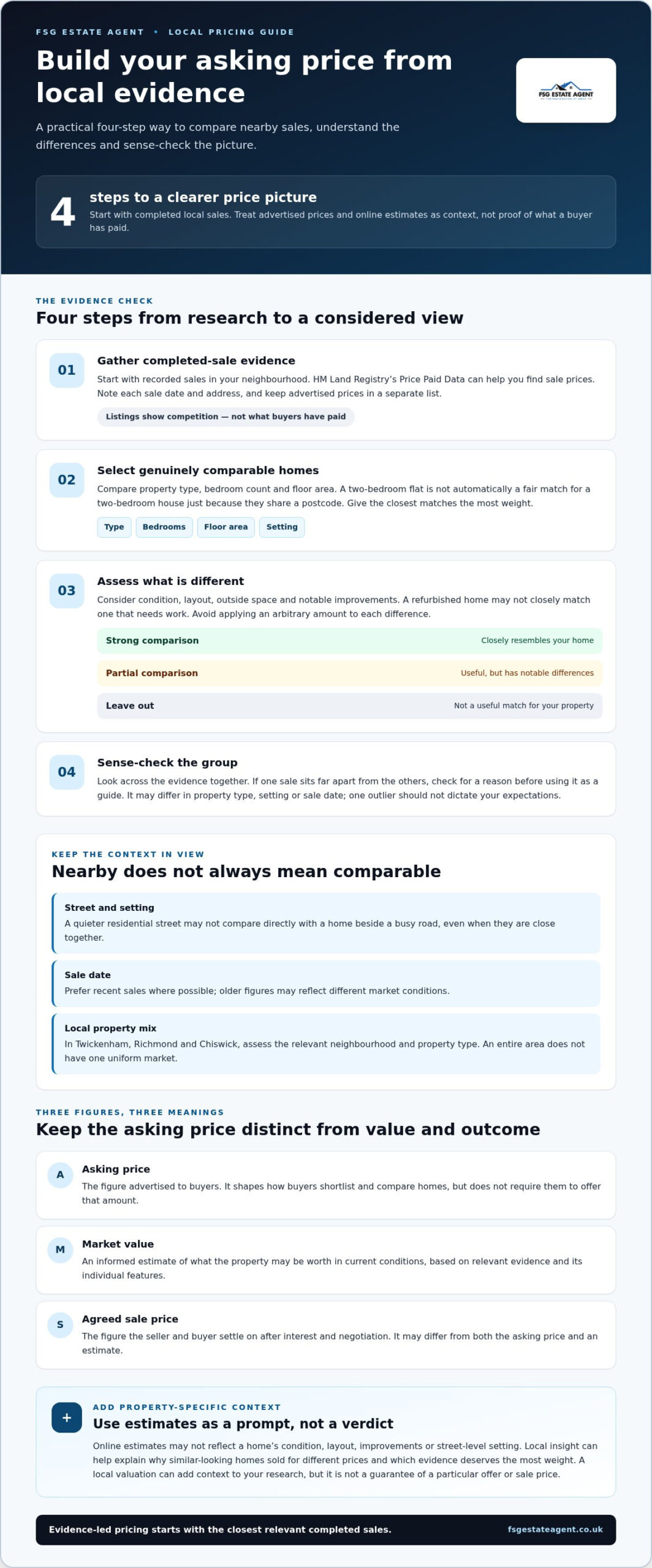
A useful comparison is more than a nearby listing with a similar number of bedrooms. The strongest evidence comes from completed sales of homes that resemble yours in type, size, condition and setting. Use this four-step method to build a clearer picture before deciding what the evidence says.
- Gather evidence. Start with completed sales in your neighbourhood. HM Land Registry’s Price Paid Data can help you find recorded sale prices. Note the sale date and address, and keep advertised prices in a separate list. Listings show the homes you’ll be competing with, not what buyers have paid.
- Select comparable homes. Look for properties similar to yours in type, bedroom count and floor area. A two-bedroom flat is unlikely to be a fair comparison for a two-bedroom house simply because they share a postcode. Give the closest relevant matches the most weight, rather than building the longest list.
- Assess the differences. Consider condition, layout, outside space and notable improvements. A refurbished home may not be a close match for one needing work. Don’t apply an arbitrary amount to each difference. Instead, judge whether a sale is a strong comparison, a partial one or best left out.
- Sense-check the picture. Look at the evidence as a group. If one sale sits far apart from the others, look for a reason before treating it as a guide. Check whether it differs in property type, setting or sale date, and avoid letting one outlier dictate your expectations.
Choose comparable homes carefully
Distance matters, but so does context. A home on a quieter residential street may not be directly comparable with one beside a busy road, even if they’re close together. Prefer recent sales where possible, as older figures may reflect different market conditions. In Twickenham, Richmond and Chiswick, assess the relevant neighbourhood and property type rather than assuming an entire area has one uniform market.
Use online estimates and local knowledge in context
Online estimates can be a handy first reference, but they may not reflect a particular home’s condition, layout, improvements or street-level setting. Treat them as prompts for further research, not as a property-specific valuation. Local insight can help explain why two apparently similar homes attracted different prices and which sales deserve most weight. This is also a useful point to consider how to choose an estate agent in Twickenham, paying attention to how well they understand the area and differences between its properties.
Once you’ve gathered your evidence, a local specialist’s valuation can add context to your research. FSG’s complimentary local property valuation considers current market value and your home’s individual features, giving you a more informed basis for the next pricing decision.
Choose a pricing strategy that fits your property and priorities
The right asking price isn’t only about the property. It also needs to fit your plans. A seller moving for a new job with a fixed date may make a different choice from someone who can wait. Before deciding how to price a house for sale, consider your timing, onward plans, financial needs and room to be flexible.
Set priorities before choosing the asking price
Write down two figures: your ideal outcome and the minimum acceptable net result after relevant selling costs and your onward-moving plans. They serve different purposes. Your ideal helps you discuss an opening strategy; your minimum gives you a private boundary for considering offers. Neither should be chosen in isolation from the evidence for comparable homes.
Then be honest about timing. Is your moving date fixed, or could you adapt it? Would a delay affect your next purchase or other plans? Your answers can help you weigh the trade-offs without assuming that a particular price will deliver a particular result.
Understand the trade-offs between pricing approaches
There’s no approach that suits every property or seller. Use this comparison to frame the discussion, then test each option against the local evidence and your priorities.
| Approach | May suit you if | Trade-off to consider |
|---|---|---|
| Evidence-led | You want the asking price to sit broadly in line with comparable completed sales. | It may feel less ambitious than your ideal figure, but can help buyers assess the home against similar options. |
| More ambitious launch | You have flexibility and a clear reason to test a higher figure against the market. | If buyers see better-aligned alternatives, the asking price may limit early interest. Be prepared to review it against the response. |
| Quicker-sale priority | Your plans make timing especially important and you’re open to a more competitive position. | A lower starting point may not suit your financial priorities, and it can’t guarantee a faster sale or a particular offer. |
Does a more ambitious price automatically give you more negotiating room? No. Buyers compare the advertised figure with similar homes and their own budgets. A price well above the evidence may put some off before they view, rather than simply giving you space to negotiate. A price aligned with comparable evidence may appeal to buyers looking for value. Competitive interest is possible, not assured, and depends on how buyers respond.
Talk through the evidence, your preferred timing and your flexibility before settling on an approach. A complimentary local property valuation can add context to that decision, helping you consider a realistic starting point without treating it as a guaranteed sale price.
How to check and adjust your asking price after launch
Launching your property gives you new evidence, but one quiet day or a single buyer’s comment isn’t enough to settle the question. Before marketing begins, agree a review point with your sales agent and decide what information you’ll consider together. That gives you a planned moment to assess the response instead of changing the price on impulse.
There’s no universal number of days to wait or standard reduction that suits every home. The right time to review depends on your property, your priorities and the evidence available once it’s on the market. Keep your preferred moving date and minimum acceptable net result in view, but assess buyer behaviour rather than letting either dictate a change automatically.
Read buyer response as evidence, not a verdict
Look for a pattern across enquiries, viewings and feedback. Few enquiries may suggest the listing isn’t reaching or appealing to enough suitable buyers. Viewings without offers may point to a mismatch between expectations and the home, its presentation or its price. One reaction is only one perspective, so look for consistent feedback before drawing a conclusion.
At your review, consider the evidence together:
- Enquiries: Are prospective buyers asking to view, or are conversations stopping after they see the advertised price or details?
- Viewings: Are people arranging visits but not progressing? Look for repeated comments about condition, layout or value.
- Comparable listings: Have similar properties appeared, changed price or left the market? Compare like with like in the relevant neighbourhood, whether that’s Twickenham, Richmond or Chiswick.
Where reliable information is available, compare the response to your listing with relevant competing homes. Don’t treat another property’s asking price as proof of value, though. It’s part of the competition, not evidence of what a buyer will agree to pay.
Decide when a price review makes sense
Review the comparable evidence if competing listings or market conditions have shifted since launch. Then discuss what the response suggests alongside your timing, onward plans and flexibility. A price change may be worth considering if the evidence points to a gap, but first consider whether presentation, viewing access or the property’s fit for buyers could explain the response.
A useful review ends with a clear decision: keep the price and continue monitoring, address a presentation or marketing issue, or discuss a change supported by the evidence. This is a more grounded way to consider how to price a house for sale after launch than reacting to an isolated comment or applying a fixed percentage reduction.
Thoughtful follow-up matters too. Read about what sellers should expect from a residential property sales agent to understand how communication and sales progression fit into the wider process.
For a property-specific review of current market value, arrange a complimentary local property valuation with FSG Estate Agent.
Set your house price with clear local advice and a considered plan
You’ve looked at comparable sales, considered your home’s features and thought about your priorities. Now bring those points together. A clear pricing decision should have a reason behind it and a plan for what you’ll do if buyer response or local market evidence changes.
Use this checklist to keep the decision grounded:
- Local sold evidence: Focus on completed sales in the relevant part of Twickenham, Richmond or Chiswick, not broad area averages alone.
- Comparable homes: Give most weight to properties similar in type, size, layout and setting.
- Condition and features: Consider how your home’s presentation, improvements and distinctive features compare with those examples.
- Your priorities: Be clear about preferred timing, onward plans, flexibility and the minimum net result you can accept.
This framework turns how to price a house for sale into a practical decision rather than a guess. Your own research is a useful starting point, and a property-specific valuation can help you interpret it.
What a useful local valuation should help you understand
A local specialist can assess your home alongside current market evidence, taking account of its particular features and condition. A useful conversation should make the reasoning clear: which comparable sales carry weight, where homes differ, and how your plans shape the recommended asking-price approach. The valuation is an informed view of current market value, not a promise of the figure a buyer will offer or the price you’ll ultimately agree.
FSG Estate Agent provides complimentary, no-obligation valuations from local property specialists. The aim is to give you property-specific context, not pressure you into a decision. Use the discussion to test your research, raise questions and understand the thinking behind a suggested price.
Turn the pricing decision into a clear next step
Before marketing starts, make sure you’re comfortable with the evidence, the asking-price approach and the point at which you’ll review the response. If your circumstances change, your priorities can inform the next discussion too. Clear expectations at the outset help keep decisions considered rather than reactive.
Pricing also connects with what happens next. Professional marketing presents the property to prospective buyers, while buyer negotiation and attentive sales support help you assess interest and work through offers. Neither removes uncertainty, but a clear plan gives you a sound basis for decisions throughout the sale.
If you’re preparing to sell in Twickenham, Richmond or Chiswick, you can discuss your property, plans and the evidence behind its price with FSG Estate Agent. Start with an open conversation and decide on the next step with a clearer view of your options.
Take your next step with a clear pricing plan
You don’t need to find a figure that removes every uncertainty. You need a price you can explain, a plan that reflects your priorities and a sensible way to respond as buyers provide new information. That’s a more useful foundation than trying to predict every offer before your home reaches the market.
If you’re still weighing up how to price a house for sale, a conversation with a local property specialist can help you apply the evidence to your home and plans. FSG’s complimentary, no-obligation valuation gives you a chance to discuss the reasoning behind a suggested asking price. Professional marketing and proactive sales progression then support the process, with personal guidance from valuation through to completion.
Bring your questions, moving plans and research to FSG Estate Agent. Arrange a complimentary, no-obligation property valuation and take the next step with a clearer view of your options.
Frequently Asked Questions
Can I set any asking price I like for my house?
You can choose the figure you advertise, but buyers aren’t obliged to treat it as the home’s value. A figure well above similar properties may lead people to focus on alternatives, while one below your expectations could invite offers that don’t meet your plans. Before deciding, compare the price with relevant sales and consider what you’d do if offers come in below your preferred amount.
Should I use an online house valuation to set my asking price?
Use an online estimate as a starting point, not as the final word. A tool may not account for a renovated kitchen, an awkward layout or differences between two nearby streets in Richmond or Chiswick. Compare its result with completed sales and your home’s actual condition. If estimates vary, look at what information each tool uses rather than simply choosing the highest figure.
Should I price my house slightly below market value?
Not automatically. A lower asking price may make your property appear more competitive to some buyers, but it doesn’t ensure extra viewings, competing offers or a particular sale price. Consider this approach alongside your financial needs, timing and local evidence. For example, if you need flexibility to negotiate, decide in advance what offer you’d consider rather than assuming a lower opening figure will create a bidding contest.
How do I know whether two houses are comparable?
Ask whether a buyer choosing between them would see them as realistic alternatives. Check property type, bedroom count, floor area, layout and condition, then consider the setting. A flat near a station may attract a different audience from a house on a quieter street, even nearby. In Twickenham, compare homes in the relevant neighbourhood, not simply those sharing the same town name.
What should I do if my house gets no viewings?
Review the listing with your sales agent before changing the price. Check whether the photographs and description show the home clearly, whether viewing arrangements are practical and whether the advertised figure matches buyers’ alternatives. Consider whether enquiries are stopping at the price or whether the property is reaching the right audience. The answer can help distinguish a pricing concern from a presentation or access issue.
Does improving my house mean I can ask for more?
Not necessarily. An improvement may make your home more appealing, but its cost doesn’t automatically add the same amount to its market value. A fresh, well-presented room may help buyers picture themselves living there, while a highly personal renovation may not suit everyone. Consider how the work compares with similar homes and whether it changes the home’s condition or usefulness, rather than pricing from your renovation bill alone.
How often should I review my house asking price?
Agree a review point with your sales agent before the property launches, then revisit the price when there’s enough meaningful response to assess. There’s no fixed interval that suits every sale. In between reviews, keep track of enquiry levels, viewing comments and changes to comparable listings. If a new competing home appears or your circumstances shift, bring that evidence into the next discussion.