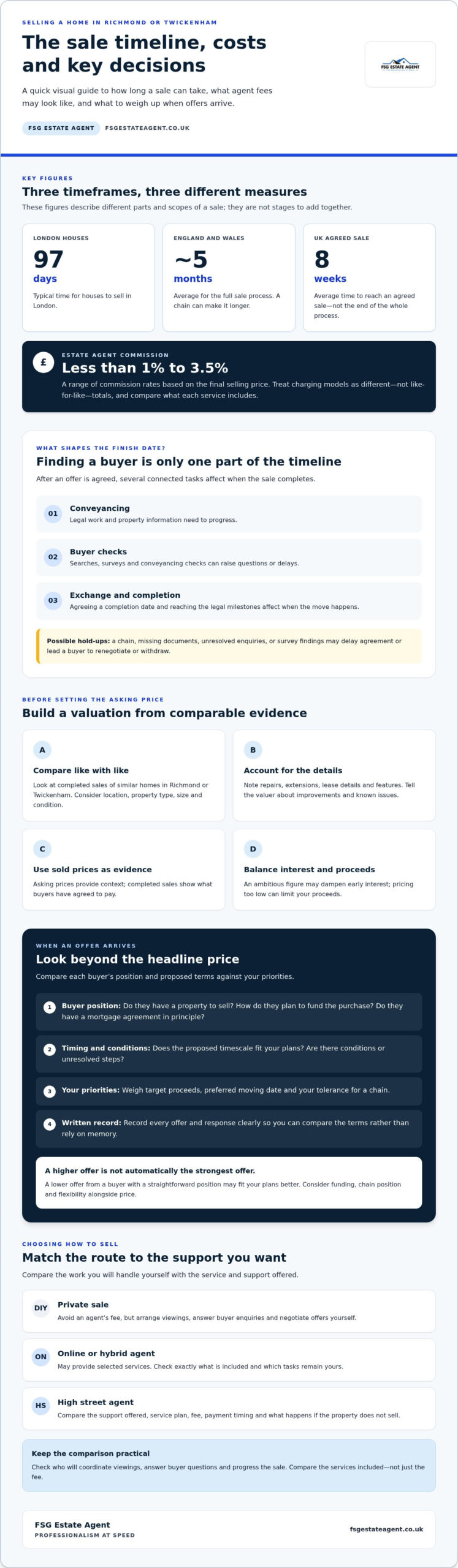
If you’re weighing up how to sell my property in Richmond or Twickenham, houses in London typically take around 97 days to sell, while the full sale process in England and Wales averages about five months. A chain can make the process longer. The timeline depends on more than finding a buyer: legal work and the steps to exchange and completion also matter.
Selling can raise plenty of questions. What is a realistic asking price? How do you assess an offer, choose an agent and prepare the paperwork? Clear answers make it easier to plan your next move.
This guide explains how a valuation is reached, what to consider when offers arrive, and how different ways of selling compare. It also covers Energy Performance Certificates and the information buyers may need, so you can prepare for each stage.
Key Takeaways
- Compare DIY, online and high street routes by weighing the work you’ll handle yourself against the support you want.
- Assess an offer on more than its price: consider the buyer’s position and how the proposed timing fits your plans.
- A verbal acceptance doesn’t make a sale legally binding; in England, the key point is exchange of contracts.
- Prepare the property information early, including its Energy Performance Certificate. According to the UK legislation register, the seller and anyone acting on their behalf must try to ensure an EPC is available within 7 days of the property first being put on the market.
- Look for a clear service plan that explains how the agent will market the property and progress the sale.
How quick is the process to sell a house fast in London?
In London, houses typically take around 97 days to sell. Across England and Wales, the full process averages about five months, and chains can extend it. A UK sale takes an average of eight weeks to reach an agreed sale, so finding a buyer is only one part of the timeline. Conveyancing, buyer checks and agreeing a completion date all affect when the sale finishes.
Costs depend on the route you choose. That total can include conveyancing and other sale expenses. An estate agent’s commission can range from less than 1% to 3.5% of the final selling price. Treat these as different charging models, not like-for-like totals.
A fixed fee is a set charge, while a percentage-based fee changes with the sale price. Before appointing an agent, compare the services included, when payment is due and what happens if the property does not sell. Private sellers avoid an agent’s fee, but must arrange viewings, answer buyer enquiries and negotiate offers themselves.
Probate and power of attorney can add practical steps. For a probate sale, establish who is authorised to handle the estate and gather property information before marketing. If someone is selling under power of attorney, organise the relevant authority documents early to support the conveyancing process. Keep the solicitor, agent and any co-owners informed.
Take sensible precautions when arranging private viewings. Let someone know who is visiting and when, and check that you are communicating with the person or business you intend to contact. Avoid sharing personal details on social media. Record offers and the buyer’s position in writing.
If you’re selling a rented property, check whether Capital Gains Tax may apply. The tax position depends on your circumstances, so raise it when arranging financial advice. Local factors also shape demand: in Richmond and Twickenham, property type, condition, asking price, transport access and nearby amenities can affect which buyers consider a home and how quickly they act.
Leasehold means owning a time-limited interest in a property, while freehold generally includes ownership of the property and land. Ownership arrangements differ across England, Wales, Scotland and Northern Ireland, so identify the title type before marketing.
Searches, surveys and conveyancing checks can uncover issues with boundaries, title, planning, property condition or lease terms. Missing documents, unresolved enquiries or survey findings can delay agreement or lead a buyer to renegotiate or withdraw.
Initial property valuation and offer
A useful valuation is based on evidence, not simply the price a seller hopes to achieve. Compare completed sales of similar homes in Richmond or Twickenham, taking account of location, property type, size and condition. A flat with a balcony may attract different buyers from a house with a garden, even on a nearby street. Asking prices offer context, but completed sales show what buyers have agreed to pay. If you’re thinking, “I want to sell my property in Richmond,” start by understanding how your home compares.
Walk through the property before settling on a price. Note repairs, extensions, lease details and features that could affect how buyers compare it with other homes. Give the valuer accurate information about improvements and known issues. A considered asking price can attract relevant viewings; an ambitious figure may dampen early interest, while pricing too low can limit your proceeds. Decide what price and sale conditions would meet your needs before marketing begins.
When an offer arrives, look beyond the amount. Ask whether the buyer has a property to sell, how they plan to fund the purchase and whether they have a mortgage agreement in principle. Consider their proposed timescale and any conditions. A lower offer from a buyer with a straightforward position may suit your plans better than a higher offer that depends on unresolved steps. Record each offer and your response clearly, so you can compare the terms rather than rely on memory.
Negotiations can cover price, fixtures and fittings, and preferred completion timing. If you want to counter, make a clear proposal and state any important conditions. You can accept, reject or negotiate. In England and Wales, verbal acceptance does not make a sale legally binding; a private treaty sale becomes binding at exchange of contracts. In Scotland, the binding point is conclusion of missives.
Competing offers call for a consistent process. With a sealed-bid approach, interested buyers submit their best offer by a stated deadline without seeing rival bids. This can help you compare proposals fairly, but the highest figure alone does not identify the strongest buyer. Consider funding, chain position and flexibility alongside price. Tell each buyer what information you need, then assess every offer against the same factors.
Before choosing, write down your priorities: target proceeds, preferred moving date and tolerance for a chain. If you’re thinking, “I’m ready to sell my property in Twickenham,” use those priorities to judge offers against your plans, not just the headline figure. A local valuation can help set a reasoned asking price using nearby comparable sales and your home’s specific features. Explore a property valuation as a practical starting point.
Choosing between DIY, online and high street agents
The right approach depends on how much of the sale you want to manage. A DIY sale leaves advertising, enquiries, viewings and negotiations in your hands. Online or hybrid agents may provide selected services, while an estate agent may offer more direct support. For a Richmond flat, consider who will coordinate viewings and answer buyers’ questions about condition, lease details and access.
Compare fees on the same basis. High street estate agents usually charge between 0.75% and 3% of the agreed sale price, plus VAT. These figures describe different charging structures, so check what each package includes before comparing the total. An agent must confirm its charges and commission rate when agreeing to act for you.
A fixed fee is a set amount under the agreed terms; a percentage-based fee changes with the sale price. Compare what the service includes, when payment is due, and whether viewings, buyer communication and sales progression are covered. A low headline fee, for example, may leave you arranging viewings yourself. Check that the written agreement clearly sets out the service.
Online and hybrid services can suit homeowners who are comfortable communicating digitally and taking on some tasks. Depending on the package, you may need to arrange appointments, meet viewers or handle offer discussions. Find out who responds to buyer enquiries and how updates are provided. For a property needing careful explanation, such as a leasehold home with detailed service-charge information, clear and timely answers matter.
An estate agent can offer a local point of contact and handle practical parts of marketing and viewings. Check how the property will be advertised, who will conduct appointments and how you’ll receive feedback. Condition and presentation also affect marketing. Agree how photographs and listing details will accurately show features such as a garden, parking or recent improvements.
DIY sellers should account for the work behind the apparent saving. Private sellers cannot list properties directly on Rightmove or Zoopla. You’ll also need to prepare accurate property details, respond to enquiries and arrange viewings. Consider whether you have the time and confidence to manage each step.
Before signing, read the agreement and compare the service line by line: advertising, viewings, offer handling, communication, charges and cancellation terms. A clear comparison helps you choose based on the work you want covered, not simply the headline fee. Keep a copy of the agreed terms and the agent’s confirmed commission rate with your sale paperwork.
Energy Performance Certificates and buyer paperwork
Prepare the Energy Performance Certificate (EPC) before launching your sale. According to the UK legislation register, the seller and anyone acting on their behalf must try to ensure an EPC is available within 7 days of the property first being put on the market. Property sales advertisements should show the EPC rating, a requirement applying from 9 January 2013, according to the UK legislation register. An EPC for a UK property is valid for 10 years, according to the UK legislation register. Find the certificate and check its date before arranging advertising.
Buyers consider the rating alongside the property’s layout, condition and running costs. If the certificate is still valid, keep a copy ready for enquiries. If a new assessment is needed, arrange it before marketing so the rating can appear in the advertisement.
Good marketing helps potential buyers understand what the home offers. Give accurate details about room sizes, heating, tenure, parking and recent improvements. Clear photographs and a well-prepared description help viewers decide whether the property suits them. For example, explain a garden’s access and maintenance needs rather than relying on a photograph alone. Keep every claim consistent with the documents you can provide.
Before the first viewing, gather paperwork that may answer common questions. Useful records include title information, guarantees for completed work, planning or building-control documents, and details of fixtures included in the sale. Organise these in one folder for your solicitor. If a buyer asks about an extension or replacement windows, relevant records can help avoid repeated enquiries.
During viewings, make access straightforward and keep a record of each potential buyer’s questions. After an appointment, note their feedback and any follow-up information they need. If a survey later raises an issue, respond with relevant documents or a clear explanation of the property’s history. Timely, factual replies can help both sides understand what needs resolving.
Choosing a buyer involves more than selecting the highest offer. Compare the proposed price with the buyer’s funding position, chain status and preferred timescale. Ask your estate agent to record those details and communicate any conditions clearly. A buyer who can explain their position and respond promptly may offer a more workable route than one with unanswered questions. Keep the EPC, property information and viewing feedback organised as the transaction moves towards conveyancing.
Estate agency service plans
A service plan sets out what an estate agent handles from instruction through to completion. Compare the practical work included, not just the plan’s label. One package might cover advertising and offer handling, while another could leave you arranging viewings and responding to buyers. Write down the support you need before appointing an agent, especially if work or a mortgage chain limits your availability.
Map each plan against the stages of your sale. Ask who prepares the property particulars, manages enquiries, conducts viewings and reports feedback. Then check what happens after you accept an offer. Will the agent contact the buyer’s solicitor, follow up on outstanding enquiries and keep you updated as contracts progress? Clear responsibilities reduce the risk of assuming someone else is handling an important task.
Pay close attention to how a plan charges. A percentage-based fee changes with the final sale price, while a fixed fee remains set under the agreed terms. Some plans charge even if the property does not sell; under a no-sale-no-fee arrangement, payment is linked to a successful sale. Read the written terms for the payment trigger, VAT, additional charges and agreement duration. Compare the total commitment, not just an attractive headline.
Support can matter most when a sale becomes complicated. If your buyer is waiting for their own sale, ask how the agent will track progress through the chain. If a survey prompts questions, establish who will pass information between you, the buyer and their solicitors. Proactive sales progression can help keep outstanding tasks visible, but make sure you know who your point of contact is and how updates will arrive.
Before deciding, make a simple comparison table. Use the same headings for each option: marketing, viewings, offer communication, sales progression, payment terms and cancellation. Mark each item as included, excluded or charged separately. This makes gaps easier to spot. For instance, a plan that covers advertising but not accompanied viewings may not suit you if you cannot attend appointments.
Ask for the service and charges in writing before appointing an agent. Keep the agreement with your sale paperwork and refer to it as the sale progresses towards contracts and completion. The right plan is the one whose defined work matches the help you need, not the one with the broadest-sounding name.
If you’re ready to compare a hands-on sales service with your priorities, discuss your property sale and the support you want through to completion.
FSG Estate Agent: Property Sales Agency Service
FSG Estate Agent provides a full residential property sales service for homeowners in Richmond, Twickenham and Chiswick. Local property expertise and a personal service, with direct contact with Fran from valuation through to completion, support you throughout the sale.
Professional marketing includes photography, listing creation and buyer outreach. After an offer is accepted, proactive sales progression manages the steps involving buyers and solicitors, with completion support to help keep the transaction moving. You remain involved in key decisions and receive direct support throughout.
If you’re preparing to sell in Richmond, Twickenham or Chiswick, arrange a free, no-obligation valuation with FSG Estate Agent to discuss your next step.
Make your next move with a clear plan
Before putting your home on the market, decide what a successful move looks like for you. Is your priority a particular moving date, room to negotiate or keeping disruption manageable? Write down what matters most and where you can be flexible. These priorities give you a useful basis for decisions as the sale progresses.
If you’re planning to sell your property in Richmond, Twickenham or Chiswick, choose support that fits the way you want to manage the process. FSG Estate Agent provides a full residential sales service with local property expertise and direct contact with Fran. Talk through your priorities and arrange a free, no-obligation valuation as a practical first step.
Take the first step at your pace. Contact FSG Estate Agent to discuss your plans. A clear starting point can make the decisions ahead feel more manageable.
Frequently Asked Questions
What are the first steps I should take to sell my property?
Start by confirming who owns the property and whether anyone else must agree to the sale. Check your mortgage paperwork for early repayment conditions, then gather title information, guarantees and records of alterations. Decide when you hope to move and which sale terms matter most. Next, arrange a valuation and choose how you’ll manage marketing, viewings and buyer enquiries. Preparing paperwork early can help you answer questions promptly.
What are the steps to sell a property in the UK?
The broad journey is to prepare the home and paperwork, set a price, market it, consider offers, instruct a solicitor or licensed conveyancer, answer legal enquiries, exchange contracts and complete. The exact legal process depends on the property’s location: Scotland uses a different contract process from England and Wales. Keep your identification, title details and property information organised so your legal representative can prepare the sale file efficiently.
How much does it cost to sell a house in the UK?
Budget for more than the estate agent’s fee. A seller’s costs may include conveyancing, an EPC if a new one is needed, removals and mortgage-related charges. The amount depends on the property, the service you choose and your onward move. Ask for a written breakdown of professional costs, including VAT and expenses, and check your mortgage terms for any early repayment charge before estimating your proceeds.
How do UK estate agent fees compare with online agents and selling privately?
Traditional agents commonly charge a percentage of the agreed price, while online or hybrid services may charge a fixed fee. Private sellers avoid an agent’s fee but take on marketing, enquiries, viewings and negotiations themselves. Compare written terms, payment timing and included tasks, not just the headline figure. For example, find out whether accompanied viewings and post-offer sales progression are included or remain your responsibility.
What documents and certificates are needed to sell a UK property?
Gather your title information, identification, mortgage details, planning or building-control records for alterations, and guarantees for relevant work. Leaseholders may also need information about the lease and charges affecting the property. Your solicitor will use these details to prepare the legal sale pack and respond to the buyer’s enquiries. Keep documents together and note any missing records early, especially paperwork relating to extensions, windows or heating systems.
How long does it take to sell a property in the UK?
The timetable depends on how quickly you find a suitable buyer and how smoothly the legal work proceeds. A chain, mortgage arrangements, survey findings or unanswered conveyancing enquiries can add time after an offer. To reduce avoidable pauses, return forms promptly, arrange access for surveys and keep your solicitor informed of changes. If you’re buying another home too, coordinate both transactions and discuss timing before agreeing a completion date.
How is a UK property valued, and how should I set the asking price?
A valuation considers comparable completed sales, location, size, condition, layout and features such as parking or outdoor space. Asking prices can show competing properties, but they do not prove what buyers ultimately pay. Give the valuer accurate details about improvements and known issues. Before choosing an asking price, consider your moving plans and how the property compares with similar homes currently attracting buyer interest.
What are the UK rules on Energy Performance Certificates when selling a home?
According to the UK legislation register, sellers and anyone acting for them must try to make an EPC available within 7 days of first marketing the property. Sales advertisements should display its rating, a requirement applying from 9 January 2013, and an EPC lasts 10 years, according to the UK legislation register. Find the certificate before advertising, check its date and have the rating ready for listing details and buyer enquiries.