Could the paperwork behind your flat matter as much as its asking price? If you’re working out how to sell a flat in Twickenham, prepare both from the start. Hauscope recorded a median sold price of £445,000 for flats across TW1 and TW2 in the 12 months to July 2026. That provides context, but your flat’s value depends on its own features, condition and lease details.
It’s understandable to be unsure what to gather, how to price a distinctive property or whether leasehold questions could hold things up. A clear plan helps you make decisions at each stage and reduce avoidable surprises.
This guide covers the practical steps: organising documents, understanding the lease and related costs, preparing for viewings, setting an asking price using local evidence, and managing offers through to completion. A considered valuation is a useful starting point. At FSG Estate Agent, Fran works directly with clients, from valuation and professional marketing through buyer negotiation and proactive sales progression. FSG supports local sellers in Twickenham, Richmond and Chiswick.
Key Takeaways
- Follow a clear sequence, from preparing and valuing your flat to completing the sale.
- Gather property and leasehold details before marketing so you’re ready for buyer questions.
- Compare similar Twickenham flats by size, condition, tenure and distinctive features before deciding on an asking price.
- Present your flat with accurate particulars and clear photography, then assess viewing feedback in context.
- Understanding how to sell a flat in Twickenham includes preparing for conveyancing, enquiries and steady coordination after an offer is accepted.
How selling a flat in Twickenham differs from selling a house
A clear sequence makes a flat sale easier to manage: prepare the property and its information, agree a considered value, launch the marketing, negotiate an offer, progress the sale and complete. Getting the details ready early helps you answer buyer questions and understand what needs to happen next.
Finding a buyer is not the same as completing a sale. An accepted offer starts the legal and practical work needed to transfer ownership. The time this takes varies with the parties, their legal work and whether there’s a chain. The sale therefore needs attention after an offer, as well as before one.
That’s the practical shape of how to sell a flat in Twickenham. The broad stages are familiar from selling a house, but a flat sale can involve extra information about the lease and shared parts of the building. Preparing for likely questions helps you give buyers a clearer picture.
- Prepare: organise property details and documents you hold.
- Value: consider relevant evidence for your particular flat.
- Launch: present it accurately to suitable buyers.
- Negotiate: assess each offer and the buyer’s position.
- Progress: keep communication moving as legal enquiries are handled.
- Complete: reach the agreed handover once the sale is ready.
What makes a flat sale different?
As well as bedrooms, condition and layout, buyers may ask about tenure, lease information, service charges and shared building arrangements. These details help them understand ongoing responsibilities and the property’s wider setting.
Leasehold means the flat is held under a lease. With a share of freehold, flat owners also collectively own a share of the building’s freehold, although the flat may still have a lease. The exact position depends on the title and documents. For detailed questions about your title or lease terms, speak to your conveyancer. Having relevant information ready helps your agent respond clearly to general buyer enquiries.
What local buyers may compare in Twickenham
Buyers are likely to compare your flat with similar options, rather than every property on the market. Look at location, floor area, condition, layout and features such as a balcony, garden or other outside space. Tenure and building details can also affect how buyers compare two apparently similar flats. A broad local average is context, not a promised value for your home.
TW1 and TW2 are useful search-area references, but a postcode alone doesn’t determine a flat’s value. Twickenham’s location and varied neighbourhoods help provide context for buyers exploring the area; Twickenham, London offers a general overview. For sellers in Twickenham, Richmond and Chiswick, local positioning also depends on how a flat’s specific features compare with nearby alternatives. For practical points to consider when selecting a selling partner, see the Twickenham estate agent selection guide.
Prepare your Twickenham flat and paperwork before marketing
Good preparation makes it easier to present your flat accurately and answer questions as they arise. Start with what you know, then organise the documents you hold. The conveyancer handling your sale can advise which legal paperwork is needed for your circumstances.
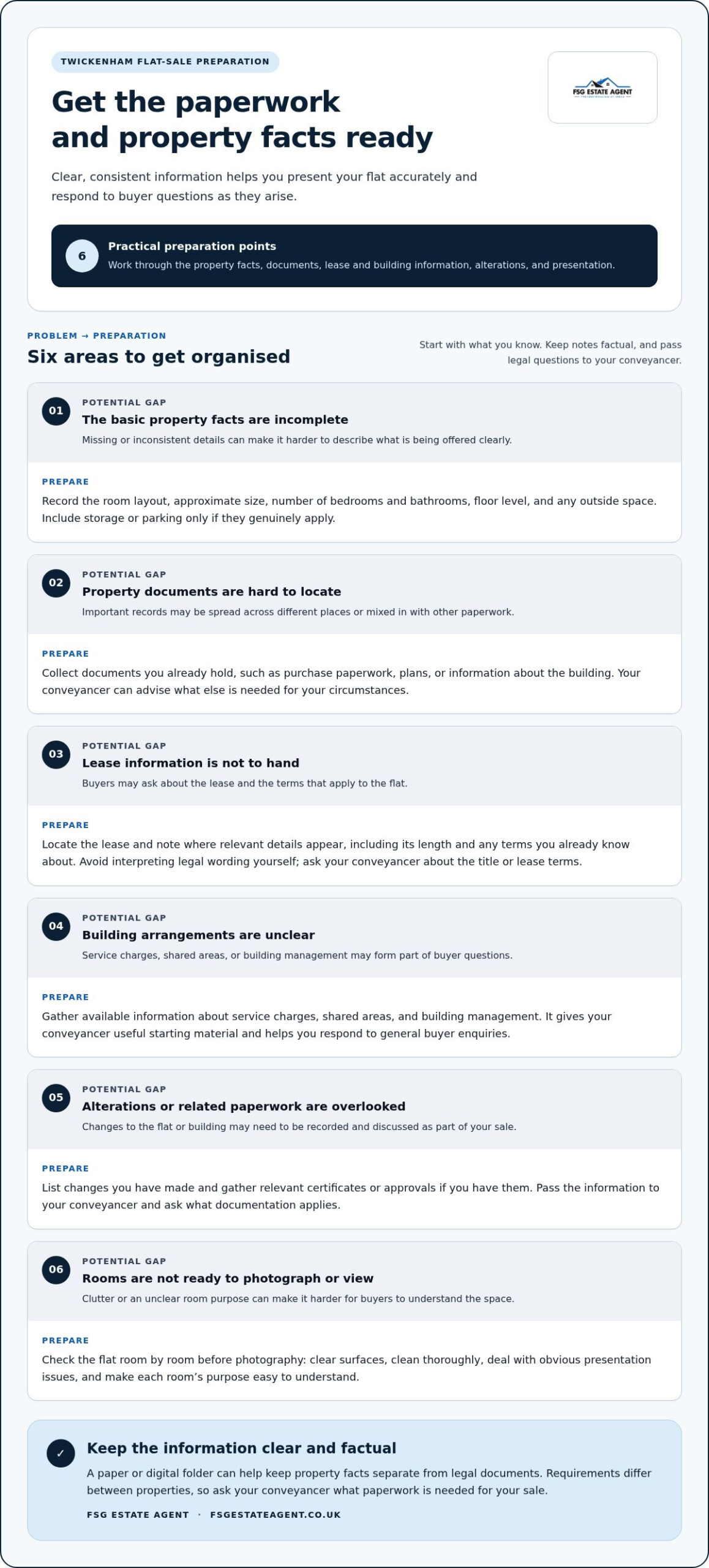
Having accurate flat information ready before launch helps create clearer marketing and gives buyers a reliable picture of what’s on offer. Use this checklist to get organised:
- Write down the property facts. Record the room layout, approximate size, number of bedrooms and bathrooms, floor level and any outside space. Include features such as storage or parking only if they genuinely apply.
- Gather property documents. Collect paperwork you already hold, such as purchase documents, plans or information about the building. Your conveyancer can guide you on what else is needed.
- Locate lease information. If the flat is leasehold, find the lease and note where relevant details appear, including its length and any terms you already know about. Avoid interpreting legal wording yourself.
- Collect service-charge and building details. Gather available information about service charges, shared areas and building management. It gives your conveyancer useful starting material and helps you respond to general buyer questions.
- List alterations and related paperwork. Note changes you’ve made to the flat or building. Gather relevant certificates or approvals if you have them, then ask your conveyancer what documentation applies.
- Check the presentation room by room. Before photography, clear surfaces, clean thoroughly and deal with obvious presentation issues. Make each room’s purpose easy to understand.
Which flat details should you gather?
Keep your notes factual and consistent. For example, describe a room as a study only if that’s how it’s arranged and presented. Use an approximate size only if you have a reasonable basis for it. A paper or digital folder can help keep property facts separate from legal documents.
Lease, service-charge and building-management information can be useful to your conveyancer, but requirements differ between properties. If you’ve changed the layout or carried out work, record what you know and pass relevant paperwork on for advice. Don’t assume every alteration needs the same documents.
How to make the flat ready for viewings
Presentation doesn’t mean disguising the property. Clear excess belongings, clean windows and surfaces, and make small, straightforward fixes where needed. Leave enough furniture to show how people might use the space, while keeping routes between rooms open. Buyers should be able to picture the layout without working around clutter.
Condition can prompt questions during a sale. The RICS Home Survey Standards describe professional residential survey practice; a survey is distinct from your marketing description. Keep particulars honest, and don’t imply a repair has been completed or a feature exists if it hasn’t.
Preparing the documents and presentation together is a practical first step in how to sell a flat in Twickenham. If you’d like a considered starting point for your asking price, you can arrange a complimentary property valuation.
How to price and position a flat for sale in Twickenham
A considered asking price starts with evidence about your flat, not a headline figure taken from a broad area average. Flats can differ considerably in size, condition, tenure and layout, even within the same part of Twickenham. Identify genuinely comparable properties, then use that context to decide how to position yours.
Keep two figures distinct: the asking price is the advertised starting point, while the achieved sale price is the amount agreed with a buyer. An asking price is not a promise of what a buyer will pay, and a marketed price alone doesn’t show what a property eventually sold for. Neither figure guarantees the result for your flat.
Which comparable flats are genuinely useful?
Start with flats in a similar location and of a similar type. Then compare details that could affect how buyers view each home. A larger flat in different condition or with different tenure may be less useful than a nearby property with a similar layout and finish. Treat each comparison as a clue, not a direct price formula.
Use this framework to assess the properties you find:
| Factor | What to compare |
|---|---|
| Location | Street, immediate surroundings and proximity to the places buyers value. |
| Size and layout | Approximate floor area, room arrangement and how usable the space feels. |
| Condition | Overall presentation, finish and any visible work a buyer may need to consider. |
| Flat position | Floor level, access and any relevant building features. |
| Outside space | Whether there’s a balcony, terrace or garden, and how it relates to the flat. |
| Tenure | Leasehold or share of freehold, where the listing provides that detail. |
Listings help you see current competition and how flats are being presented. An advertised price, however, is not evidence of a completed sale price. Give more weight to relevant sold-price information where available, while remembering that public records may not explain every difference between properties.
How a valuation can inform your asking price
A local specialist can assess your flat’s features alongside relevant local evidence, then discuss a pricing strategy with you. This is more useful than relying on one nearby listing or a general average. A complimentary, no-obligation valuation can provide a practical starting point, not a guarantee of the eventual sale price. Ask how condition, tenure and distinctive features inform the recommendation.
Pricing is one part of how to sell a flat in Twickenham. Positioning also means presenting the flat’s genuine strengths clearly, so suitable buyers can understand what makes it different. For a fuller picture of the support involved, see what sellers should expect from a residential sales agent.
Launch your Twickenham flat sale and handle offers carefully
Once your asking price and property information are ready, make it easy for buyers to understand what’s being offered. Accurate particulars, clear photography and exposure to relevant buyers help set expectations and give viewers a useful basis for deciding whether the flat suits them.
Good marketing doesn’t mean making the property sound better than it is. Show its strengths clearly, answer likely questions and keep details consistent from the listing through to viewings. As you work through how to sell a flat in Twickenham, steady buyer interest is more useful than reacting to every comment or changing the price immediately.
What should a clear flat listing include?
Describe the layout, condition and tenure accurately. Make notable features easy to understand, whether that’s a balcony, a particular room arrangement or a shared building feature. Use photographs that represent the flat honestly and help buyers understand how the rooms connect. Avoid angles or descriptions that could give a misleading impression of size, condition or outlook.
Local context can help buyers picture daily life, but keep it factual. Name nearby places or transport links only where the location supports the claim. Don’t suggest a station, park or other amenity is closer or more convenient than it is. Accurate particulars reduce confusion and help viewings focus on whether the flat is the right fit.
Viewings also provide useful information. Listen for recurring questions or points of confusion. If several viewers misunderstand the layout, for example, clarify the description or photographs. One person’s preference isn’t a reason on its own to change the asking price. Consider feedback alongside the level and quality of interest before deciding whether anything needs to change.
How to assess an offer beyond the headline figure
The largest offer may not be the only one worth considering. Look at the whole proposal and discuss its strengths and uncertainties before deciding:
- Buyer position: Is the buyer selling another property, or do they have a related purchase to complete?
- Funding progress: What has the buyer said about their arrangements, and what steps remain?
- Proposed timing: Does their preferred timescale fit your plans, and is it realistic for the people involved?
- Conditions: Are there matters the buyer wants resolved or clarified before proceeding?
Keep a written record of the offer and any agreed terms. Pass the details promptly to your conveyancer so the legal work can be considered and progressed. An offer is an important step, but it doesn’t mean the sale is complete. Clear communication helps you make an informed decision and identify what needs attention next.
If you’re considering a sale, arrange a complimentary, no-obligation valuation as a straightforward first step towards a considered launch plan.
From offer to completion: sell your Twickenham flat with steady support
An accepted offer is a welcome milestone, but work remains before the sale completes. Conveyancing, enquiries and coordination between the people involved all need to move forward. Timing depends on the legal work, the buyer’s and seller’s circumstances, and whether either side is part of a chain. Treat an exchange or completion date as provisional until the relevant steps are in place.
What happens after accepting an offer?
Once you accept an offer, the agreed terms are passed to the conveyancers and the legal process begins. Your conveyancer handles the legal work and advises on documents or enquiries. The buyer’s conveyancer may raise questions about the flat, its lease or the building. Responding clearly and promptly can help keep matters moving, although some answers may take time to obtain.
A typical sequence includes:
- Confirm the agreed terms: make sure the price and any other agreed points are recorded accurately.
- Instruct conveyancers: provide the information and paperwork requested so they can begin the legal work.
- Respond to enquiries: your conveyancer handles formal legal questions and lets you know where your input is needed.
- Coordinate the chain: if other sales or purchases are connected, progress depends partly on those transactions too.
- Prepare for exchange and completion: dates are discussed as the parties and legal work progress. They can change, so avoid firm moving arrangements based only on an early estimate.
After exchange, the parties are committed to the transaction under the agreed contract. Completion is the final stage, when the sale is concluded and the buyer can take possession. Your conveyancer will explain the steps and what you need to do at each point.
How FSG supports sellers from valuation to completion
Clear communication matters throughout this stage. Your estate agent can keep you updated on buyer responses, help coordinate communication between the parties and follow up on outstanding points. The agent doesn’t replace your conveyancer or give legal advice. Proactive sales progression helps keep the practical parts of the transaction visible, so delays or unanswered questions can be raised and followed up.
At FSG, Fran works directly with clients throughout the sale. Professional marketing presents the flat to buyers, buyer negotiation helps you consider offers, and proactive progression supports the agreed sale through to completion. You have a personal point of contact to discuss progress and understand what needs attention next.
If you’re planning how to sell a flat in Twickenham, a conversation can help clarify your priorities before you begin. Talk through your Twickenham flat sale and arrange a complimentary, no-obligation valuation, with no pressure to proceed.
Take the next step with a clear plan
Your next move doesn’t need to be a commitment to sell. It can simply be a chance to talk through what matters to you, whether that’s timing, your flat’s particular features or understanding your options before deciding. A focused conversation can turn uncertainty into a practical starting point.
If you’re considering how to sell a flat in Twickenham, begin with a valuation based on your property and its local context. It gives you a chance to discuss an asking-price strategy and decide what feels right for your plans, without pressure to proceed.
Arrange a complimentary, no-obligation property valuation and take the next step when you’re ready. With a clear plan, you can approach the sale with greater confidence.
Frequently Asked Questions
How long does it take to sell a flat in Twickenham?
There’s no single timeline for every flat. GetAgent reported that properties in Twickenham spent an average of 15 weeks on the market in October 2026, but that figure isn’t a promise for an individual sale or the time to completion. Finding an acceptable offer is only one stage. Pricing, buyer circumstances, conveyancing and any chain can all affect progress.
What paperwork do I need to sell a leasehold flat?
The documents depend on the property and sale. Start by locating your lease and any service-charge statements, building-management information or correspondence you already hold. For example, a recent service-charge statement may help identify the managing organisation and charges, but it won’t replace the formal information needed for the transaction. Your conveyancer can tell you which legal documents and replies are needed in your particular case.
Can I sell my flat if I do not know how many years are left on the lease?
Start by finding the lease or title information and asking your conveyancer to establish the remaining term. It may be relevant to a buyer’s assessment, but there isn’t one universal lease-length threshold that determines every sale or lender’s decision. Avoid guessing in conversations or marketing. Accurate information helps you answer questions clearly and lets your conveyancer advise on the implications for your specific flat.
Do I need to redecorate my flat before selling it?
No, a full renovation isn’t automatically necessary. Focus first on clean, uncluttered rooms and straightforward presentation that helps buyers see the space and its current condition. If a wall needs touching up or a cupboard is difficult to open, consider whether a modest fix is worthwhile. Don’t assume costly changes will increase the sale price. Weigh the flat’s condition against likely buyer expectations before spending.
Can I sell a flat in Twickenham while it is rented out?
A sale may be possible while a flat is occupied, but the tenancy agreement and circumstances affect how it should be handled. Discuss your legal obligations and the appropriate process with your conveyancer rather than assuming vacant possession is always required or acting on general advice. Make sure the listing describes the occupancy accurately and viewing arrangements reflect the tenant’s situation and the agreed process.
Should I accept the highest offer for my Twickenham flat?
Not necessarily. Consider the full offer, including the buyer’s position, funding progress, preferred timing and any conditions. A higher offer may come with circumstances or dependencies that need discussion, while another buyer may have a different timescale. Ask your agent to set out the available information clearly, then weigh the options against your plans. No offer guarantees completion.