An estate-agent appraisal and a formal valuation are not the same thing. For a house valuation in Richmond, start with a free, no-obligation appraisal from FSG Estate Agent. A local property expert assesses your home and its likely sale price using comparable properties and local market knowledge. This gives you a practical guide to setting an asking price, not a formal valuation report.
It’s sensible to want a clear figure before deciding what to do next. But Richmond prices vary by property type, condition and location, so borough-wide averages offer context rather than a price for your home. Recent sales can show the range, while a tailored appraisal helps you understand how your property compares. This article explains how to arrange a free estimate, interpret local sale prices and distinguish an agent’s appraisal from a formal valuation.
Key Takeaways
- Arrange a free local appraisal to get an estimate based on your home and relevant nearby sales.
- Use borough-wide averages as context, then compare them with prices for similar homes in your area.
- Understand the difference: an estate-agent appraisal helps guide a sale price, while a formal valuation serves a different purpose.
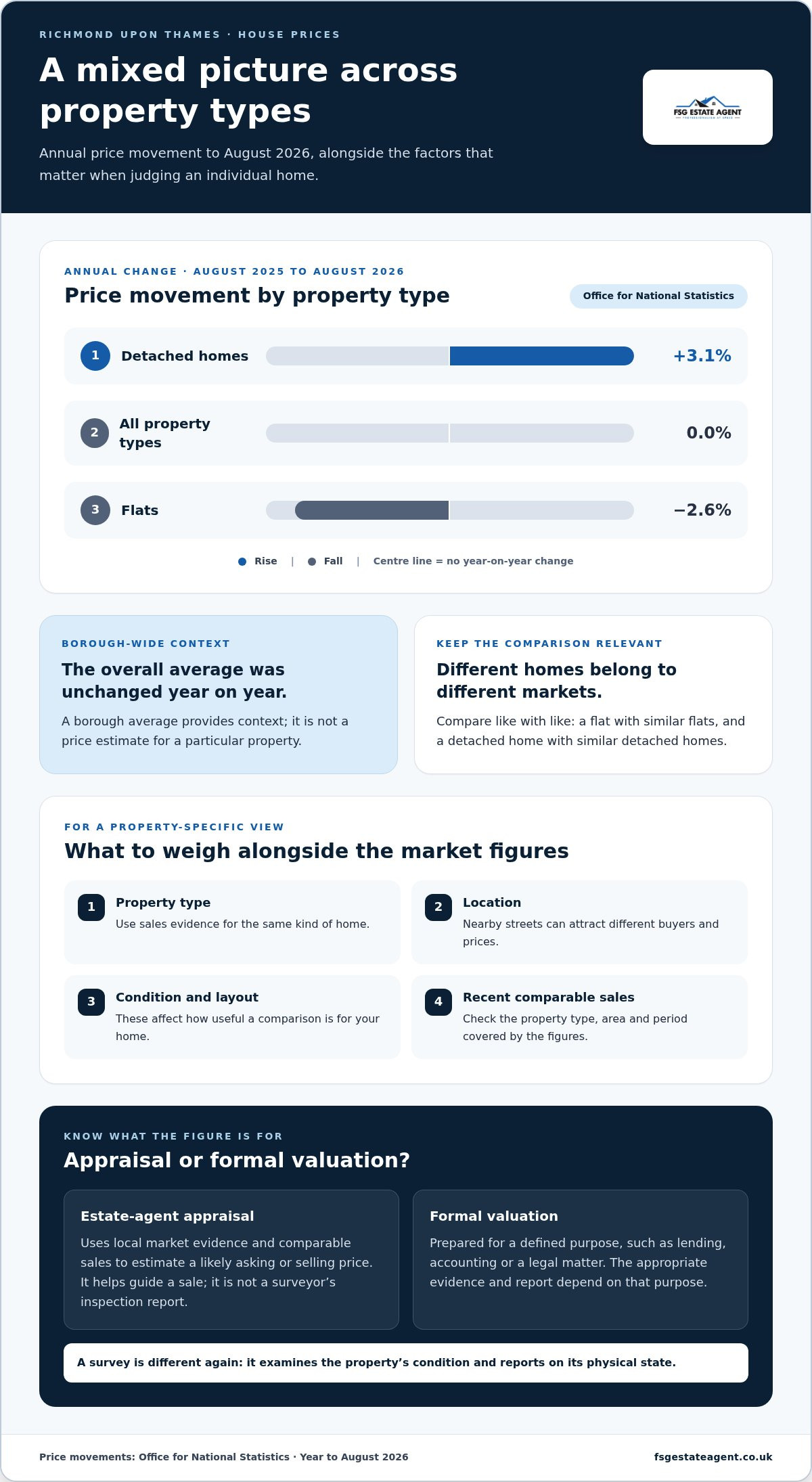
- Detached property prices in Richmond upon Thames rose by 3.1% in the year to August 2026, according to the Office for National Statistics.
- Look at property type, location and recent market movement together before deciding on an asking price.
How do I get a free property valuation in Richmond?
Arrange a free, no-obligation appraisal of your Richmond home with FSG Estate Agent. Before the visit, tidy each room, ensure key areas are accessible, and make a note of improvements, repairs and features that may affect value.
For a useful estimate, share the property’s address, type, number of bedrooms and any recent changes. Mention extensions, a modernised kitchen, new windows or alterations to the layout. These details help a local expert compare your home with relevant evidence, rather than relying on a broad estimate for Richmond upon Thames.
Local knowledge matters because nearby streets can attract different buyers and prices. A valuation considers comparable properties, including similarities in building materials and geographical location. Local knowledge is a mandatory requirement of the Royal Institute of Chartered Surveyors for property valuation. An agent familiar with Richmond can explain how a home’s condition, setting and features reflect its likely market position.
Recent examples show the range across property types and neighbourhoods. These are examples, not direct substitutes for your home: condition, size, layout and exact location all influence how useful a comparison is.
When arranging an appointment, explain whether you want an estate-agent appraisal to help with a possible sale or a surveyor’s report for another purpose. An appraisal estimates a likely asking or sale price from market evidence. A survey examines the property’s condition and reports on its physical state. Being clear about your purpose helps identify the right type of visit and report.
During an appraisal, expect the agent to view the rooms, discuss the property’s features and consider comparable local evidence. Ask how the estimate was reached, which property types and nearby sales were considered, and what could affect buyer interest. A clear explanation helps you understand the reasoning, not just the figure.
FSG Estate Agent provides a direct point of contact with Fran, who works with you throughout the sale process. Prepare your questions, share accurate details about your property and arrange a suitable visit. An estimate is most useful when its comparisons match your home’s location, condition and features.
How much does the average property sell for in Richmond?
The average house price was unchanged year on year at 0.0% in August 2026, according to the Office for National Statistics. A borough-wide average gives context, but your property value depends more closely on its type, condition and street.
The average price of detached properties rose by 3.1% in the year to August 2026, according to the Office for National Statistics. The average price of flats fell by 2.6% in the year to August 2026, according to the Office for National Statistics.
Neighbourhoods cannot be ranked reliably using borough averages alone. Compare similar residential properties on the same street or nearby, accounting for property type and condition. A detached home and a flat in Richmond upon Thames belong to different markets, even when they share a postcode.
Richmond sold-price figures also vary by source and geographic area. These figures should not be treated as interchangeable with the borough-wide average. Check whether a figure covers Richmond itself or Richmond upon Thames, which property types it includes and the period it measures.
Buyer type gives another basis for comparison. These figures describe different buyer groups, not a guaranteed selling price for an individual home.
Online valuation tools can offer a starting estimate, but they rely on available sales data and property details. They may not reflect renovations, layout, condition or features that distinguish your home from similar properties. A local appraisal can take those details into account.
Published averages can change as transactions are recorded and data is revised. Local housing data also draws on fewer properties than national estimates, making short-term movements more variable. The Office for National Statistics advises looking at trends over a year or longer. Compare periods consistently before interpreting a rise or fall.
An inaccurate estimate can affect your asking price and selling decisions. Pricing too high may reduce buyer interest; pricing too low may leave value unrealised. An online figure is best used as an initial reference, then weighed against relevant sales and your property’s condition. For a property-specific view, explore a free Richmond property valuation.
Estate agent appraisals versus formal valuations
An estate agent’s appraisal estimates a likely selling price using local market evidence. It helps you consider an asking price and plan a sale. A formal property valuation is prepared for a defined purpose, such as lending, accounting or a legal matter. The right option depends on the decision the figure needs to support.
During an appraisal, an agent considers the property’s condition, layout, location and comparable sales. They may also discuss buyer interest and how an asking price could position your home. For example, a Richmond upon Thames flat should be compared with similar flats, not detached houses elsewhere in the borough. An appraisal is practical sales guidance, not a surveyor’s inspection report.
A formal valuation requires a valuation purpose and an appropriate evidence base. The current RICS Valuation – Global Standards edition took effect on 31 January 2025. Local knowledge is a mandatory requirement of the Royal Institute of Chartered Surveyors for property valuation. A chartered surveyor considers relevant comparable evidence, including similarities in building materials and geographical location.
A mortgage valuation serves the lender, not the buyer’s full understanding of the home’s condition. It helps the lender assess whether it could recover its loan if the property had to be sold. Mortgage valuations may be based on drive-by surveys or completed remotely, without a full inspection. They should not be treated as a detailed building survey or a guarantee of the property’s condition.
A building survey has a different purpose. It examines the property’s physical condition, but does not include a valuation. A separate valuation service can be provided. If you need both a condition report and a figure, keep the two outputs distinct when reviewing reports or arranging a survey.
For court proceedings, the requirements are different from an estate-agent appraisal. Court valuation reports in England and Wales are structured according to CPR Part 35 and Practice Direction 35. Under CPR 35.3(1), experts must help the court on matters within their expertise. A court-compliant property valuation in Richmond should identify its purpose, valuation date and evidence base.
Before arranging a valuation, write down who will use it and why. If you’re setting a sale price, an estate-agent appraisal can help you assess local buyer appeal and comparable evidence. If a lender, court or formal process needs a report, its purpose determines the relevant valuation approach. Ask what the report covers, whether the property will be inspected, and how its condition and location will be reflected in the final figure.
Comparison with London and UK averages
Richmond’s average sits above wider benchmarks, but borough figures don’t price individual homes. To compare with Twickenham and Kingston, assess similar property types, locations and recent sales in each area.
Richmond against London and UK averages
These figures show how Richmond compares with broader markets, not what a specific home will sell for. Property type, condition and street still matter when forming an estimate.
Use each average for context, then compare like with like. A Richmond flat should be set against flats, not the average for every London home. Buyer-group figures describe completed purchases, rather than a private estimate of your home’s value.
Period matters too. London’s average house price fell by 2.2% in the year to August 2026. Richmond’s average house price was unchanged year on year at 0.0% in August 2026, according to the Office for National Statistics. Local housing data covers fewer properties than national estimates, so short-term movement can be more variable. Compare a year or longer, rather than treating one month as a lasting trend.
Nearby area valuation comparisons
Twickenham house prices and Kingston are useful nearby comparisons, but an area label alone cannot establish a reliable value. Compare homes with similar property types, condition, size and location, then review completed sales from a consistent period. A flat near a station and a family house on a residential street may attract different buyers, even in nearby areas.
For a practical comparison, note the address, property type and sale date for each example. Check whether the data covers Richmond, Richmond upon Thames, Twickenham or Kingston, since boundaries affect what an average includes. HM Land Registry house-price data on the page covers transactions from 1 January 1995 to 28 August 2026. Select recent, relevant evidence rather than mixing areas or periods.
Nearby figures can help test an estimate, but shouldn’t replace property-specific evidence. A home’s condition, layout and features can distinguish it from otherwise similar sales. Ask how each comparison relates to your property and why it was included. That explanation makes the estimate easier to assess and helps separate broad area averages from evidence relevant to your selling decision.
How have house prices in Richmond changed over the past year?
Richmond’s property market has shown resilience during wider fluctuations, but movement differs by property type and price band. Richmond sold prices over the last year were 12% below the 2023 peak of £1,145,784. That comparison gives useful longer-term context, but it doesn’t mean every home has followed the same path. For a seller, the relevant question is how comparable properties have performed in the same period.
This range covers a broad group, so the figure alone won’t explain demand for a particular flat. Location, condition, layout and building features all shape how buyers assess it. Compare recent sales of similar flats, then consider whether your home shares the features that made those properties appealing.
A borough-wide trend can also conceal differences between property types. Detached homes, flats and family houses attract different buyers and compete with different alternatives. A shift in one segment may have little bearing on another. When reviewing a year’s movement, separate the evidence by type and price band before drawing conclusions about your likely sale price.
Use a consistent comparison period. Richmond’s peak average sold price dates from 2023, whilst the 12% figure compares sales over the last year with that peak. Those are distinct reference points. A single recent transaction can sit above or below the wider trend because of its property’s features, condition and exact location. Several relevant comparisons give a clearer picture than one sale alone.
For a practical review, gather comparable sales and note their property type, location and timing. Then compare those details with your home. If an example differs substantially in condition or layout, give it less weight. This helps distinguish local market movement from differences between individual properties and supports a more grounded asking-price decision.
Richmond’s resilience does not remove the need to price carefully. A sale price depends on how buyers respond to the property as presented, the competition available and the evidence behind the asking figure.
Before setting an asking price, ask how the estimate reflects recent comparable evidence and your property’s condition. A clear explanation helps you understand whether the proposed figure fits your home’s segment, rather than simply following a headline trend. Arrange a free property valuation to discuss a Richmond home’s position in the current market.
FSG Estate Agent: Property Sales Agency Service
When you’re ready to move from a valuation to selling your home, FSG Estate Agent provides a residential property sales service from valuation through to completion. You deal directly with Fran, with local expertise and personal support throughout the process.
Local Property Experts can help you understand how your home fits the Richmond market and discuss a suitable approach to its sale. Professional marketing presents the property to potential buyers, while Proactive Sales Progression keeps the transaction moving after an offer is accepted. These services are useful if you want guidance beyond an estimate and a clear point of contact throughout your sale.
For a straightforward conversation about selling your Richmond home, contact FSG Estate Agent.
Turn your estimate into a clear selling plan
A house valuation in Richmond is most useful when it helps you make a decision. Before taking the next step, consider your preferred timing, any preparation your home needs and the outcome you want from a sale. These priorities give a local property expert a practical starting point for discussing your options.
FSG Estate Agent offers a personal, proactive residential sales service, with local expertise and direct contact with Fran throughout. If you’re weighing up whether to sell or ready to turn an estimate into a plan, arrange a free, no-obligation property valuation.
Bring your questions and be clear about what matters most to you. A professional, honest, friendly and proactive discussion can help turn uncertainty into a manageable next step, focused on your home and your plans.
Contact FSG Estate Agent to discuss your Richmond property. You can take the next step at your own pace.
Frequently Asked Questions
Why do I need a home valuation?
A home valuation gives you a reasoned starting point for deciding whether and how to sell. It can help you plan your finances, compare possible asking prices and discuss your next move with confidence. For example, if you’re considering a move from Richmond to Twickenham, an estimate can help you think through the sale alongside your onward plans. Treat it as a planning tool, not a promise of the final sale price.
Is local valuation knowledge necessary?
Yes, local context helps make comparisons more relevant to your home. The Royal Institute of Chartered Surveyors states that local knowledge is a mandatory requirement for property valuation. An agent familiar with Richmond can distinguish between homes that share a broad property type but differ in street, setting or buyer appeal. This matters when nearby evidence includes properties that look similar on paper but compete for different purchasers.
What is the valuation based on?
A valuation draws on comparable evidence and the details of your home. Before an appointment, prepare a short note covering improvements, alterations, known maintenance issues and features that may not be obvious during a viewing. For example, explain whether a loft space is converted or simply used for storage. Accurate details help the person assessing your home interpret its condition and compare it fairly with relevant properties.
Is there any obligation?
No. FSG Estate Agent’s initial property valuation is free and carries no obligation to sell. You can use the estimate to consider your options, ask questions and decide whether selling fits your plans. For instance, you might arrange an appraisal while weighing up a move, then take time to decide. Requesting an estimate does not commit you to selling through the agency.
What happens next?
After a valuation, you can decide whether to proceed with a sale. FSG Estate Agent’s residential sales process follows six named steps: Free Valuation, Seller Preparation, Professional Marketing, Offer Negotiation, Sales Progression and Completion. Seller Preparation covers presentation and documentation before marketing begins. If you’re selling in Richmond, Twickenham or Chiswick, use the valuation discussion to clarify your priorities and what you need to prepare next.
What is the average house price in Richmond, London?
That borough figure covers a mix of homes, so it won’t tell you what a particular property is worth. A flat, terraced house and detached home belong to different price groups. For a fair comparison, identify the property type and use a matching local average alongside evidence relevant to the specific home.
How can I get a free house valuation in Richmond?
Arrange a free, no-obligation valuation with FSG Estate Agent by contacting Fran about your property. Share its address, type, condition and any significant improvements so the assessment has useful context. You can also explain whether you’re preparing to sell or simply considering your options. FSG Estate Agent provides local market advice for homeowners selling residential property in Richmond, Twickenham and Chiswick.
What factors affect a house valuation in Richmond?
Location, property type, condition, layout and comparable local sales all influence an estimate. A well-presented home with a practical layout may appeal differently from a similar-sized property needing work. Outdoor space, room arrangements and the condition of key features can also shape buyer interest. Before an assessment, note upgrades and maintenance needs so the valuation reflects your home accurately.