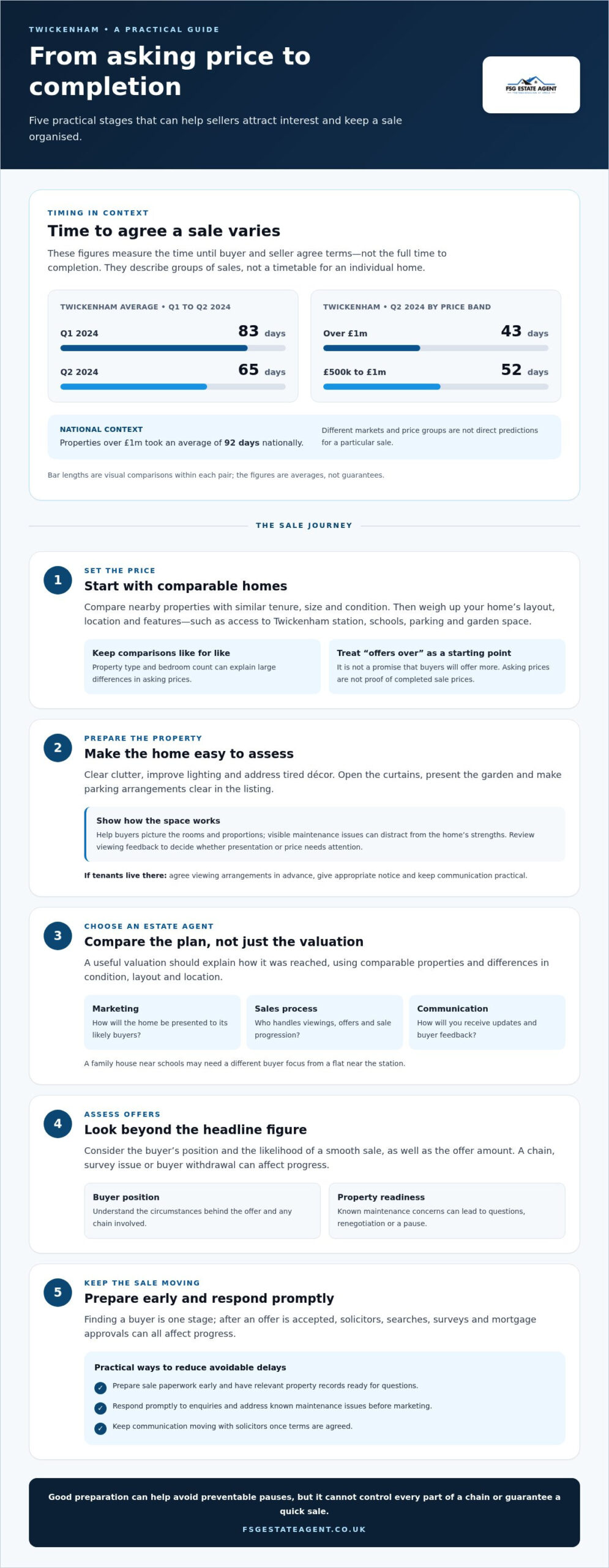
In Q2 2024, Twickenham properties priced over £1m took 43 days to find a buyer, compared with 52 days for homes priced from £500k to £1m. The average time to agree a sale across Twickenham was 65 days. For anyone selling a house in Twickenham, those figures show why price band matters, but they don’t predict the timing of an individual sale.
It’s natural to focus on the asking price and hope the right buyer comes along quickly. But your home’s appeal, how it is presented and how well the price reflects local demand all shape the response.
This guide explains how to set an asking price, assess offers and choose an estate agent, including how sale times can vary by price band in Twickenham. You’ll also find practical ways to attract interest and keep a sale moving once you have a buyer.
Key Takeaways
- Set an asking price using comparable Twickenham homes and your property’s condition, layout and location, not an optimistic guess.
- Assess offers by more than the headline figure: the buyer’s position and the likelihood of a smooth sale matter too.
- Compare estate agents on the quality of their valuation, marketing and sales progression, as well as the personal service they provide.
- Use price-band sale times as context, then weigh up how your home’s features and likely buyers affect its appeal.
- Prepare sale paperwork early and deal promptly with questions to help avoid preventable delays.
Property asking prices and offers over
Price your home against comparable Twickenham properties, then account for its condition, layout and location. Listings show a wide range, not one reliable price for every home. These are asking prices, not evidence of completed sales.
Property type and bedroom count help explain that range. A larger house in a particular setting may differ sharply from a smaller flat, so compare like with like.
Before choosing a figure, compare nearby homes with similar tenure, size and condition. Consider access to Twickenham station, schools, parking and garden space, as these can influence buyer appeal. An asking price set too high can deter early interest and extend the time it takes to sell. “Offers over” signals a starting point, not a promise that buyers will offer more. Set a price that reflects the evidence and the response you want to attract.
A leasehold flat differs from a freehold house because the sale involves lease and management information as well as the property’s condition and value. Have relevant records ready to answer buyer questions about the lease, service charges and building arrangements. A freehold sale usually centres on the house and land included in the title.
Conveyancing costs vary with tenure, legal work and transaction complexity. Leasehold sales can involve extra work to gather management information and respond to enquiries. A conveyancer’s quote sets out the cost, so consider the work covered as well as the fee.
Selling a rental property with tenants calls for clear coordination. Agree viewing arrangements in advance, give appropriate notice and keep communication practical. A tidy, well-lit home helps buyers assess the rooms and proportions, even when it is occupied.
Prepare each room before viewings: clear clutter, improve lighting and address tired décor. Open the curtains, present the garden and make parking arrangements clear in the listing. For a family house, show how the bedrooms and living spaces work day to day. A sensible layout helps buyers picture themselves there, while visible maintenance issues can distract from the home’s strengths. Review feedback after viewings and use it to decide whether the presentation or asking price needs attention.
Average time to agree a sale in Twickenham
In Q2 2024, agreeing a sale in Twickenham took an average of 65 days. The figure was 83 days in Q1 2024, showing how timings can shift between quarters.
Agreeing a sale
These averages measure the period until a seller and buyer agree terms, not the full time to completion. Property type, condition, presentation and buyer demand all affect how quickly interest turns into an offer. Family houses near popular local schools, attractive period homes on sought-after roads and move-in-ready properties may draw attention sooner.
Flats and maisonettes appeal to a different set of buyers from larger houses. Their likely buyers may weigh the commute, layout and ongoing building costs, while families viewing houses may prioritise bedrooms, garden space and parking. These are factors to consider, not a timetable for an individual property.
Properties over £1m took 92 days on average nationally. Those figures measure a different market from Twickenham’s local average, so use them as context rather than a direct prediction.
Risks and common delays
The main risks include a buyer withdrawing, an unexpected survey issue and delays within a property chain. In Twickenham, buyers may be upsizing, downsizing or relocating locally, so one slow transaction can affect others. A survey concern that could have been anticipated may lead to further questions, renegotiation or a pause.
Finding a buyer is only one stage. Solicitors, searches, surveys and mortgage approvals can all affect progress after an offer is accepted. Prepare paperwork early, respond promptly to enquiries and address known maintenance issues before marketing. These steps can reduce avoidable hold-ups, although they cannot control every part of a chain.
Compare the local average with your own priorities: a sale involving a chain may take longer to complete than a straightforward chain-free transaction. For practical Twickenham sale guidance, consider how your buyer’s position, survey readiness and paperwork could affect progress from offer to completion.
The Q1 2024 comparison point remains 83 days, but it should not be treated as a target for every seller. An average describes a group of sales, while an individual home’s progress depends on its condition, presentation, buyer interest and the position of the people involved. Sellers can use the figure as a prompt to consider what may help a suitable buyer make a decision, rather than as a promise about when an offer will arrive. Clear information about the property, readiness to answer questions and early attention to known maintenance concerns can support a more organised process. Once terms are agreed, keeping communication moving with solicitors and responding to requests can help avoid preventable pauses. Even careful preparation cannot guarantee a quick agreement or completion, particularly where a chain or survey concern affects progress.
Choosing an estate agent
Choose an agent whose valuation, marketing plan and sales process make sense for your property. In Twickenham, a family house near schools needs a different buyer focus from a flat near the station.
Estate agency services
An estate agency service can cover valuation, preparing the property for market, arranging viewings, handling offers and progressing the sale. Compare what each stage involves, who manages it and how you will receive updates. A clear plan should explain how the agent will present your home, respond to buyer feedback and maintain communication after an offer is accepted.
Look beyond the headline valuation. A useful assessment should explain how the agent arrived at the figure, using comparable properties and differences in condition, layout and location. Access to Twickenham station, garden size and parking, for example, can affect buyer appeal. A valuation without reasons gives you little basis for judging the proposed asking price.
Review the marketing approach as a practical checklist. It should explain how the property’s strongest features will appear in the listing and how viewings will be organised. A period home might benefit from having its original details highlighted; a home with an unusual layout may need a clear explanation of how its rooms work. Good presentation helps buyers understand what they are seeing.
Consider the work that follows an offer, too. Sales progression involves keeping track of enquiries, survey issues and chain updates. Clear communication matters because delays can arise between agreeing a sale and completion. Compare how the agent reports progress and handles questions, rather than judging the service by the initial valuation alone.
Local estate agents
Local knowledge is useful when it is specific. An agent familiar with Twickenham can explain how nearby schools, the river, station access, garden space and parking may shape interest in your property. Look for advice tied to your street and home, rather than broad claims about the whole area.
Test the advice against your property’s details. A practical family home with good proportions and a sensible layout may appeal to more buyers than one with an unusual layout or major renovation needs. The agent should identify both strengths and compromises, then explain how the marketing can address them clearly.
Use the valuation meeting to assess who will handle the sale. Notice whether they listen to your timing, explain their pricing rationale and answer questions about viewings and updates directly. A local estate agent should be able to discuss likely buyers for your home and the features that matter, rather than relying on a generic sales pitch.
Before deciding, compare each agent’s proposed asking price, marketing plan and sales progression approach side by side. Choose the one whose reasoning you understand and whose process fits your priorities. This gives you a clearer basis for appointing an agent and preparing your home for the market.
Twickenham sale times by price band
In Q2 2024, the time to find a buyer in Twickenham varied sharply between price bands. These figures can help you frame expectations, but they describe finding a buyer, not completing the sale.
- Over £1m: 43 days.
The pattern isn’t a steady climb as prices rise. Treat each band as a separate snapshot, not a promise about an individual home.
Twickenham’s figures also show that the higher bands weren’t automatically slower in Q2 2024. Higher-value homes can have fewer potential buyers in their price bracket, so the property’s appeal and the buyer pool both matter.
Use the figures as a prompt to examine your own asking price. First, identify the price band your home would fall into. Then compare similar local properties by type, condition and layout. A two-bedroom flat and a family house may attract different buyers, even if their asking prices fall within the same band. Location features such as station access, parking and garden space can also shape interest.
Next, consider whether your asking price sits near a band boundary. A modest price change could move it into another band, but these figures alone can’t show whether that would attract more suitable buyers. Ask how the proposed price reflects comparable homes and the likely audience. Don’t assume the shortest recorded time means every property in that band will sell quickly.
Finally, separate the search for a buyer from the later sale process. A buyer may be found, yet surveys, mortgage approval, searches, solicitors or a chain can affect the route to completion. Use the Q2 2024 band figures to discuss marketing expectations, then track viewing interest and offers against your own property’s circumstances.
The 137-day result for properties priced from £300k to £400k in Twickenham in Q2 2024 is a benchmark, not a forecast for any individual home.
What legal documents and certificates are needed to sell a house in England?
Start by gathering documents that identify the property, explain its ownership and record work carried out. The exact paperwork depends on whether your Twickenham home is freehold or leasehold, and what has changed during your ownership. Keep originals safe and share copies with your conveyancer when requested.
Ownership and property details
Find your title documents, property plans and any paperwork relating to boundaries or shared access. If you can’t locate older deeds, tell your conveyancer early. For a leasehold flat, gather the lease and available details about service charges, ground rent and building management. These records help answer buyer enquiries about the property and its ongoing arrangements.
Keep records that describe what is included in the sale. For example, note which fixtures and fittings will stay, such as fitted wardrobes, curtains or kitchen appliances. A clear inventory can help prevent confusion when the buyer reviews the property information and agrees what remains.
Certificates and work records
Collect certificates, guarantees and invoices for work completed at the property. Examples include paperwork for a boiler replacement, electrical work, an extension or new windows. Planning documents and building-work records can help explain alterations. A certificate is useful only if it relates to the work and property being sold, so organise documents by project and date.
For a home with a recent roof repair, provide the invoice and any guarantee paperwork together. For a flat with replacement windows, include the installer’s documents if you have them. These records give buyers clearer information and can help your conveyancer respond to questions about past work.
Prepare a clear sale file
Create a digital or paper folder before marketing begins. Include ownership records, plans, certificates, guarantees, instruction manuals and relevant correspondence. Add a short note beside anything that needs explanation, such as an altered boundary or shared driveway. Clear labels make it easier to find the right document when questions arrive.
If tenants currently occupy the property, organise the tenancy agreement and records of communication about access. Keep these separate from ownership and repair documents. For a leasehold sale, gather available building and management information early, since it may take time to assemble.
Your conveyancer can identify which records apply to your transaction and prepare the legal paperwork for the sale. Give them accurate details about alterations, disputes, guarantees and known issues. Don’t leave gaps unexplained: flag missing or unclear paperwork promptly so the next steps are clear.
Preparing documents alongside your sale plans can make enquiries easier to manage. Discuss your property sale and how an organised launch can support a smoother process.
FSG Estate Agent: Property Sales Agency Service
FSG Estate Agent provides a Property Sales Agency Service for homeowners preparing to sell in Twickenham. Turn to the team for support with valuation, marketing and managing the sale through to completion.
Local Property Experts bring area knowledge to the valuation and marketing plan. A Personal Service gives you direct support as decisions arise, from reviewing buyer interest to considering offers. Proactive Sales Progression helps keep the transaction moving after an offer is accepted, when clear communication and prompt follow-up matter.
If you’re planning a move, start with a Free Property Valuation and discuss how your home can be presented to buyers. Contact FSG Estate Agent to talk through your sale, or visit fsgestateagent.co.uk.
Take the next step with a clear plan
Selling a house in Twickenham starts with decisions that reflect your priorities: the move you’re planning, the timing you need and the terms you would consider. Before putting your home on the market, decide what matters most beyond the asking price. A clear view of your next move can help you assess offers and make practical choices as the sale progresses.
FSG Estate Agent offers a Property Sales Agency Service delivered by Local Property Experts, with a Personal Service throughout your sale. If you’re ready to discuss your plans, share what you hope to achieve and explore a sensible next step together.
Contact FSG Estate Agent today to start a conversation about your move. A thoughtful plan can make the process feel more manageable, and you can take it one decision at a time.
Frequently Asked Questions
How long does it take to sell a house in Twickenham?
In Q2 2024, the average time to agree a sale in Twickenham was 65 days. That measures the time to find agreement with a buyer, not the entire transaction. After an offer, the buyer’s mortgage arrangements, survey findings and legal enquiries can affect progress. If you’re selling a house in Twickenham, plan for both stages and keep paperwork and responses organised.
Which estate agents in Twickenham have the best reviews and fees?
There isn’t one best choice for every seller. Compare review themes such as communication, accurate pricing advice and support after an offer, alongside each agent’s proposed marketing and sales process. Fees depend on the case and are set out after a quote request; the work involved and the property’s circumstances affect the cost. FSG Estate Agent provides local property expertise and a personal sales service.
What local factors affect house prices in Twickenham, such as schools, transport and flood risk?
School access, transport links, parking, gardens and proximity to the river can all shape buyer interest. Their influence depends on the property and the buyers it may attract. Flood exposure is location-specific, so assess the individual home rather than treating all Twickenham or riverside properties alike. Buyers may also compare nearby Richmond and Chiswick, where locations and property features differ.
What are the conveyancing costs for selling a house in Twickenham?
Conveyancing costs vary according to the property’s tenure, the legal work and the transaction’s complexity. Leasehold sales can cost more because of the extra work involved in gathering management information and answering enquiries. Review the conveyancer’s quote and the work it covers.