A valuation doesn’t commit you to selling. You can arrange a property valuation in Twickenham to understand what your home may be worth, even if a move is only a possibility. An in-person visit typically takes around 20-30 minutes, depending on the property’s size and type.
It’s reasonable to want a clearer picture before making plans. A property valuation Twickenham homeowners can use is an estimate based on the home and local market, not a promise of the eventual sale price. It can help you weigh up your options without deciding to put your property on the market.
This guide explains what an agent looks at during a visit, how comparable sales shape an estimate, and why asking prices can differ from agreed sale prices. You’ll also learn what to prepare and how to interpret a valuation, so you can understand the figure and decide what to do next.
Key Takeaways
- Use recent comparable sales to understand how property type, condition and location can shape an estimate.
- Decide whether an in-person or virtual valuation better suits your needs and the information you can provide.
- Prepare details of improvements and alterations to help make a site visit more informative.
- For taxable assets, basic-rate taxpayers pay 18% Capital Gains Tax, according to HM Revenue & Customs; a sales estimate and a tax valuation serve different purposes.
- Understand what a free, no-obligation valuation can help you decide, even if selling is not yet on your agenda.
Comparable market research and valuation reports
A useful estimate combines your property’s features with evidence from comparable homes. The right report also depends on why you need the valuation, particularly whether it’s for a sale, survey or tax matter.
Comparable market research
For a sale estimate, compare homes with similar property types, sizes, layouts and condition. Location matters too: nearby streets can attract different buyers and levels of demand. Where possible, look at completed sales, not just asking prices, which show what sellers hope to achieve. A clear valuation should explain which comparisons informed the estimate and how differences were accounted for.
Local property price comparisons
Twickenham prices can’t be compared fairly with Richmond, Teddington or London overall using a single headline figure. Property type, size, tenure and condition all affect the comparison. These are asking prices, not evidence of completed sales, so compare like-for-like properties in each area for a useful estimate. For wider context, see this guide to the property market in Richmond upon Thames.
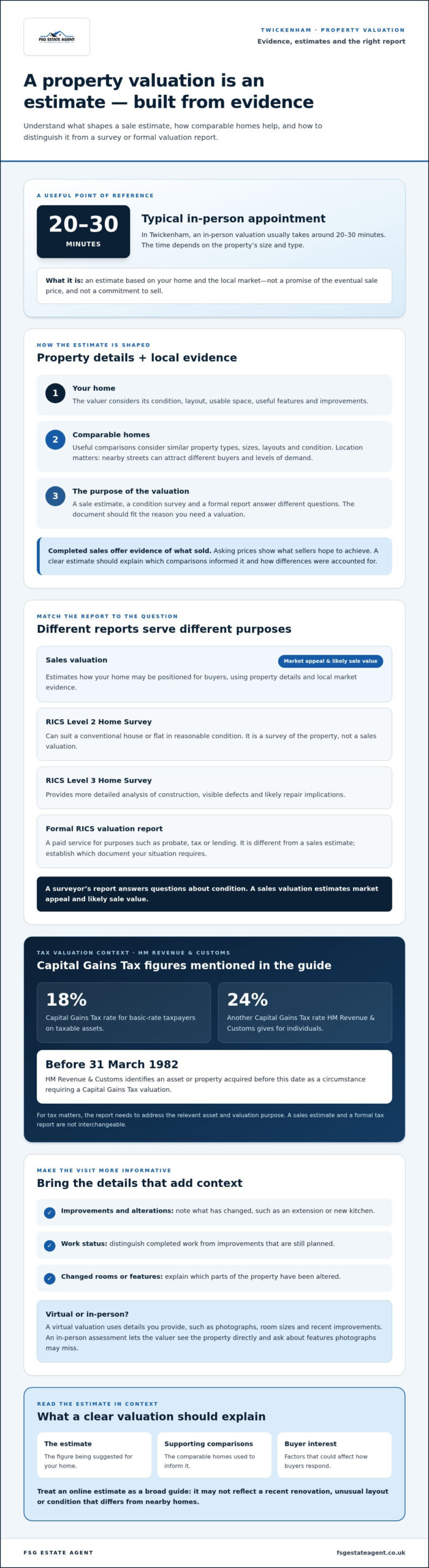
A typical in-person valuation appointment in Twickenham takes around 20-30 minutes, depending on the property’s size and type. The valuer considers its condition, layout, useful features and any improvements. They can then discuss how comparable market evidence applies to your home. Ask what the valuation report covers, including the estimate, supporting comparisons and any factors that could affect buyer interest.
A valuation is not a building survey. A RICS Level 2 Home Survey can suit a conventional house or flat in reasonable condition. A RICS Level 3 Home Survey gives more detailed analysis of construction, visible defects and likely repair implications. The surveyor’s report answers questions about the property’s condition; a sales valuation estimates its market appeal and likely sale value. Choose the report that matches your purpose.
A formal RICS valuation report is different again. It is a paid service used for purposes such as probate, tax or lending, rather than a sales estimate. HM Revenue & Customs says basic-rate taxpayers pay 18% Capital Gains Tax on taxable assets. HM Revenue & Customs gives 18% and 24% as Capital Gains Tax rates for individuals.
HM Revenue & Customs identifies an asset or property acquired before 31 March 1982 as a circumstance requiring a Capital Gains Tax valuation. For tax matters, the report needs to address the relevant asset and valuation purpose. A sales estimate and a formal report are not interchangeable, so establish which document your situation requires before relying on a figure.
How Does Property Valuation Work?
A valuation combines property details with local evidence to estimate likely market value. In Twickenham, you can start online, speak to an agent remotely or arrange an in-person assessment.
In-person and virtual valuations
A virtual valuation uses details you provide, such as photographs, room sizes and recent improvements. It can help you discuss an initial estimate without arranging a visit. An in-person assessment lets the valuer see the property directly and ask about features photographs may miss. Choose the format that suits your purpose and the detail you can share.
In-person property assessments
A typical in-person valuation in Twickenham takes around 20-30 minutes, depending on the property’s size and type. The valuer considers the layout, condition, usable space and improvements, then weighs these details against comparable local homes. Before the visit, note any alterations and be ready to explain which rooms or features have changed. This gives the discussion clearer context.
Neighbourhood and postcode values
Values vary across Twickenham because homes differ in condition, size, layout and setting, even within the same postcode. A flat near the town centre and a family house elsewhere may attract different buyers and comparable sales. Richmond, St Margarets and Teddington are nearby, but their prices shouldn’t be treated as direct substitutes. Compare similar homes in the same neighbourhood first.
Online estimate accuracy
An online estimate can provide an instant starting point, but it relies on the information and property records available to the system. It may not reflect a recent renovation, unusual layout or condition that differs from nearby homes. Treat the figure as a broad guide and compare it with local evidence. An in-person discussion can account for details an online form can’t capture.
To challenge a council tax band, explain why you believe the current band doesn’t fit your property, using comparable homes as evidence. For a mortgage valuation, raise specific factual concerns through your lender, such as incorrect property details or relevant comparable sales. Keep your evidence focused and explain how it relates to your home.
If you’re considering a sale, discuss a local property valuation to put the estimate in context. A clear conversation about your home’s details and the purpose of the valuation helps you decide what to do next.
Free, no-obligation valuations
A free valuation means there’s no charge for the appointment. No obligation means you can use the information without agreeing to put your home on the market. In Twickenham, it can help you consider your options before setting a moving date. It’s a starting point for planning, not a commitment to sell or appoint an agent.
Keep the purpose clear. A sale valuation helps you understand how your home may be positioned for buyers. It isn’t the same as a formal report for tax, probate or lending. For example, if you’re weighing up a move from a flat to a house, an estimate can help frame the decision. It won’t tell you whether moving is right for you.
To make the discussion useful, prepare a short list before the appointment. Include the property’s layout, any extensions and improvements such as a new kitchen. Note which work is complete and which is still planned. These details help explain how your home differs from nearby properties in Twickenham or elsewhere in West London.
Ask how the estimate was reached. A useful explanation should connect your property’s features with comparable homes and current buyer interest. If a figure seems higher or lower than expected, ask which features or comparisons account for the difference. A clear answer gives you something practical to consider, rather than leaving you with a figure without context.
You can also use the appointment to understand possible next steps without committing to them. Ask what would happen if you chose to sell, how the asking price would be considered, and what preparation might suit your home. A dated bathroom, for example, may affect presentation differently from a structural concern. Separate immediate repairs from cosmetic choices before spending money.
There’s no need to arrive with a decision made. You might want an estimate because you’re planning a future move, reviewing household finances or simply curious about your home’s position. Explain your reason at the start, then consider whether the estimate answers your question. If your plans change later, you can revisit the discussion with updated property details and priorities.
A no-obligation valuation is most useful when you treat it as one piece of evidence. Record the estimate, the reasoning behind it and any points you want to revisit. Then compare that advice with your plans, including timing, any work required and your preferred sale strategy. This gives you a firmer basis for deciding whether to take another step.
Site visits, photographs and measurements
A site visit lets the valuer consider your property’s details alongside its presentation and layout. They can see how rooms work together, notice improvements and identify features photographs may not show clearly. For example, a loft conversion or altered ground-floor layout can change how buyers view the available space. Accurate details help make the estimate relevant to the home you’re selling.
Before the appointment, prepare the full address, tenure, approximate age, sales particulars and details of known alterations. These give the valuer useful context and help avoid mistakes about the property. If you have plans for an extension or conversion, keep them nearby, but distinguish completed work from proposals. A planned project shouldn’t be described as part of the home’s current layout.
Measurements help describe the property’s proportions and usable space. Note room dimensions if you already have them, and flag any areas with unusual shapes or restricted access. A long, narrow reception room, for instance, may feel different from a square room with a similar floor area. The valuer can consider how the layout compares with other homes on the street.
Photographs can support the valuation discussion by recording details such as a renovated kitchen, garden access or a converted room. Clear images should show the relevant feature rather than hide it behind furniture or tight framing. They provide useful context, but don’t replace seeing how the rooms connect. If a photograph shows older décor, explain whether the room has since been updated.
Walk through the home before the visit and make a simple room-by-room note. Include upgrades, repair work and features that may not be obvious at first glance, such as built-in storage. Mention any ongoing work clearly. A recently fitted bathroom and an unfinished bathroom renovation, for example, represent different conditions for a buyer assessing the property.
Keep supporting paperwork together, including sales particulars, available floor plans and records of completed alterations. These can clarify room names, dimensions and changes from the original layout. If measurements in older plans differ from what you observe, point that out rather than guessing which figure is accurate. Clear records give the valuation discussion a stronger factual basis.
A valuation visit is not a building survey or a certification of hidden structure. Its purpose is to assess sale potential using the home’s visible condition, layout and market context. If the valuer notices a feature needing more explanation, such as an altered internal wall, share what you know and any relevant paperwork. Accurate information supports a clearer estimate and helps you plan your next step.
Twickenham and nearby areas covered
Twickenham sits within a wider south-west London market, but a nearby address doesn’t automatically make a home a close comparison. Richmond, St Margarets and Teddington are useful neighbouring reference points. A sound valuation starts with the property’s immediate surroundings, then considers whether evidence from another area genuinely matches its type and appeal.
In Richmond, St Margarets and Teddington, compare properties by their features before their postcodes. A flat should be assessed against similar flats, while a family house needs relevant house comparisons. Size, condition, layout and tenure can all affect the estimate. A similar home in a neighbouring area may offer useful context, but any differences need explaining.
Street-level context matters. Two homes in Twickenham can appeal to different buyers because of their setting, presentation or access to local facilities. A flat and a family house on the same street, for example, won’t attract the same market. Use nearby properties to understand local demand, then narrow comparisons to homes with genuinely similar characteristics.
When reviewing an estimate, ask which areas provided the comparisons. If a valuation draws on Richmond or Teddington, ask how those examples relate to your property in Twickenham. Check that the comparison reflects a similar property type and condition, rather than relying on a broad area label. This makes the reasoning easier to follow and shows where local differences influence the figure.
Postcodes can help organise search results, but they don’t describe every feature buyers consider. A boundary between Twickenham and St Margarets doesn’t make two homes identical. Look at the actual street, property layout and condition. For instance, a renovated flat may be more comparable to another updated flat nearby than to an older home across a postcode boundary.
The relevant area evidence also depends on the valuation’s purpose. For a sale estimate, focus on homes that would appeal to similar buyers and compete for the same interest. For a formal report, clarify its purpose and scope with the appropriately qualified professional, such as a chartered surveyor. The report should make clear which evidence supports its conclusion.
Before discussing a valuation, note your property’s street, type, layout and key improvements. If Richmond, St Margarets or Teddington comparisons are used, ask how they were selected. This simple step helps distinguish relevant evidence from broad regional context. A local estimate is most useful when its examples and reasoning connect directly to your home.
If you’re ready to discuss your home’s place in the Twickenham market, arrange a property valuation and explore the local comparisons behind the estimate.
FSG Estate Agent: Property Sales Agency Service
FSG Estate Agent can help when you’re ready to move from an estimate to a sale plan. Its Property Sales Agency Service brings valuation, professional property marketing and sales progression together. Local Property Experts provide a personal service, supporting you through the sales process from valuation to completion.
If you’re still weighing up your options, use the valuation to consider timing, presentation and what you want from a sale. If you decide to proceed, proactive sales progression helps keep the transaction moving, with a clear point of contact throughout.
Talk with FSG Estate Agent about your property and next steps, or visit fsgestateagent.co.uk.
Make your next move with confidence
A valuation can turn a vague possibility into a practical decision. Use the estimate to consider what matters most to you: your preferred timing, the changes you’re willing to make and the kind of move you want next. You don’t need to settle every detail at once. Start with the question you need answered.
If you’re considering a property valuation in Twickenham, FSG Estate Agent can help you decide what to do next. Its Property Sales Agency Service is supported by Local Property Experts and a personal approach, giving you a point of contact as your plans develop.
There’s no need to rush a decision. If selling becomes the right choice, a clear conversation can help you move forward on your terms. Contact FSG Estate Agent to discuss your property and what you’re considering.
Take the next step when you’re ready, with a clearer view of your options.
Frequently Asked Questions
Can I get a valuation if I’m not ready to sell?
Yes. You can request a valuation to help plan ahead, even without choosing a moving date. Use the estimate to think through possible improvements, future plans or whether a move suits your circumstances. FSG Estate Agent offers a free property valuation, so you can explore your home’s market position without deciding to list it. A sales estimate isn’t a formal tax or lending report.
How long does the valuation process take?
An in-person valuation visit typically takes around 20-30 minutes, depending on the property’s size and type. Allow time to discuss features that need context, such as a converted loft or a recently altered layout. Before the appointment, gather any useful details about improvements and tenure. The visit is only one part of the process; the estimate also involves considering relevant local market evidence.
How much is my house worth in Twickenham?
Your home’s value depends on its type, size, condition, layout and exact setting. A renovated family house and an unmodernised flat won’t attract the same comparisons, even if they’re close together. Start by identifying similar homes nearby, then consider how your property differs. For a more tailored estimate, arrange a property valuation in Twickenham and discuss the features that affect buyer appeal.
Is an online house valuation free?
An online estimate may be available without charge, but it’s an automated indication rather than a detailed assessment of your home. FSG Estate Agent offers a free property valuation to give you a more informed view of your property’s sale potential. An online form, for example, may not capture a new extension or unusual floor plan. Share those details during a valuation discussion.
What Determines Property Value in Twickenham?
Property value reflects a home’s features and market evidence for similar properties. Buyers may consider bedroom numbers, usable space, condition, outdoor space and the cost of any work needed. A refurbished flat, for example, may attract different interest from one needing modernisation. The strength of the comparable evidence matters too: homes that closely match yours provide a more useful basis for an estimate.
What is the average property value in Twickenham in 2026?
These are different measures of advertised prices, not a single value for every property type. A house valuation needs relevant house comparisons; flat figures alone won’t establish its likely market value.
What factors affect property valuations in Twickenham, including transport links and schools?
Transport links and nearby schools can shape how buyers assess a location, alongside the property’s condition, layout and local setting. Their influence depends on what likely buyers prioritise. One buyer may value a straightforward commute, whilst another focuses on school access or outdoor space. Compare homes appealing to similar buyers, rather than assuming one local feature determines value.
How can I get a free property valuation in Twickenham?
Contact FSG Estate Agent to arrange a free property valuation. Share the property’s address and explain any completed improvements or layout changes. Mention a new kitchen or converted room, for example, to help put the home in context. A local property expert can discuss the estimate and how it relates to your plans, whether you’re preparing to sell or simply planning ahead.