A postcode gives you a starting point, not your home’s full value. To understand what your property is worth, look at recent sold prices for comparable homes and adjust for your property’s size, condition, features and the market. In Richmond, Twickenham and Chiswick, nearby sales are most useful when the properties are genuinely alike.
It’s natural to want one clear figure, especially if you’re thinking about selling. Online estimates can offer a rough guide, but they can’t account for the details that make your home different. This guide explains how to use local sold prices, compare nearby properties and assess the features that shape a realistic estimate.
You’ll also learn where postcode tools can fall short and when a property-specific valuation can give you a clearer picture. The aim is to help you understand the evidence behind your home’s value, rather than rely on a number in isolation.
Key Takeaways
- Use recent sold prices for genuinely comparable homes in Richmond and Twickenham as a starting point.
- Treat postcode estimates as broad guides: they may reflect past sale prices and market changes, not your home’s individual features.
- Compare location, size, condition, amenities and current market conditions to understand what may shift an estimate.
- Allow for a delay before recent sales appear in Land Registry records, so the latest local evidence may not yet be visible.
- A property-specific valuation can help turn online estimates and nearby sales into a more informed selling decision.
Accuracy and limitations of online valuations
An online estimate can provide an initial reference point, but it cannot inspect your home in Richmond, Twickenham or Chiswick. Treat it as a guide, then weigh its assumptions against evidence specific to your property.
Online estimate accuracy
Online valuations use available property and sale information to produce an estimate, not a full inspection. They may miss details such as condition, layout or improvements that distinguish your home from nearby properties. Check what information the estimate uses and whether it reflects your property’s actual features. A figure generated without seeing your home is a starting point, not a formal valuation.
Free instant estimates
A free instant online valuation offers a quick initial figure. That speed can help with early planning, but the estimate may not account for changes inside your home or details absent from records. Use it to frame questions, not as the sole basis for setting an asking price or making an offer. Compare its assumptions with relevant local sales.
Accurate property valuations
For a property-specific valuation, an estate agent can visit your home or make a virtual assessment using details you share online. A visit lets the property’s condition, size and features inform the appraisal. For lending, tax, probate or legal purposes, use a qualified valuer or surveyor. A UK mortgage lender will require a valuation to confirm the property’s value.
How much does a RICS chartered surveyor valuation cost in the UK? There is no single price for every property. The cost depends on the property and the valuation’s purpose and scope; you’ll receive a fee after requesting a quote.
Before an appointment, gather details that may affect the valuation. For a leasehold property, have information about its costs and charges ready, as these can affect its value. Be prepared to describe the home’s condition and any improvements, so the assessment can take account of details an online estimate may miss.
When using valuation evidence to make an offer, compare the property with similar homes and recent sold prices. An online figure can help you begin, but it is not a formal mortgage or RICS valuation and should not be the sole basis for buying or selling. Check whether the comparison reflects the property’s size, condition and features before deciding what the evidence suggests.
Can I check a house value by postcode?
Yes. A postcode can give you a broad estimate, while selecting your address provides a more specific starting point. In Richmond, Twickenham and Chiswick, treat the result as an indication, not a precise valuation.
Online and agent valuations
A postcode calculator estimates value using available sale prices and UK house price inflation figures. It can show how values have changed over the past year, but it doesn’t inspect your home. An estate agent can assess the property in person or make a virtual valuation using details you share online. This property-specific view adds context that a postcode alone cannot provide.
Factors affecting estimates
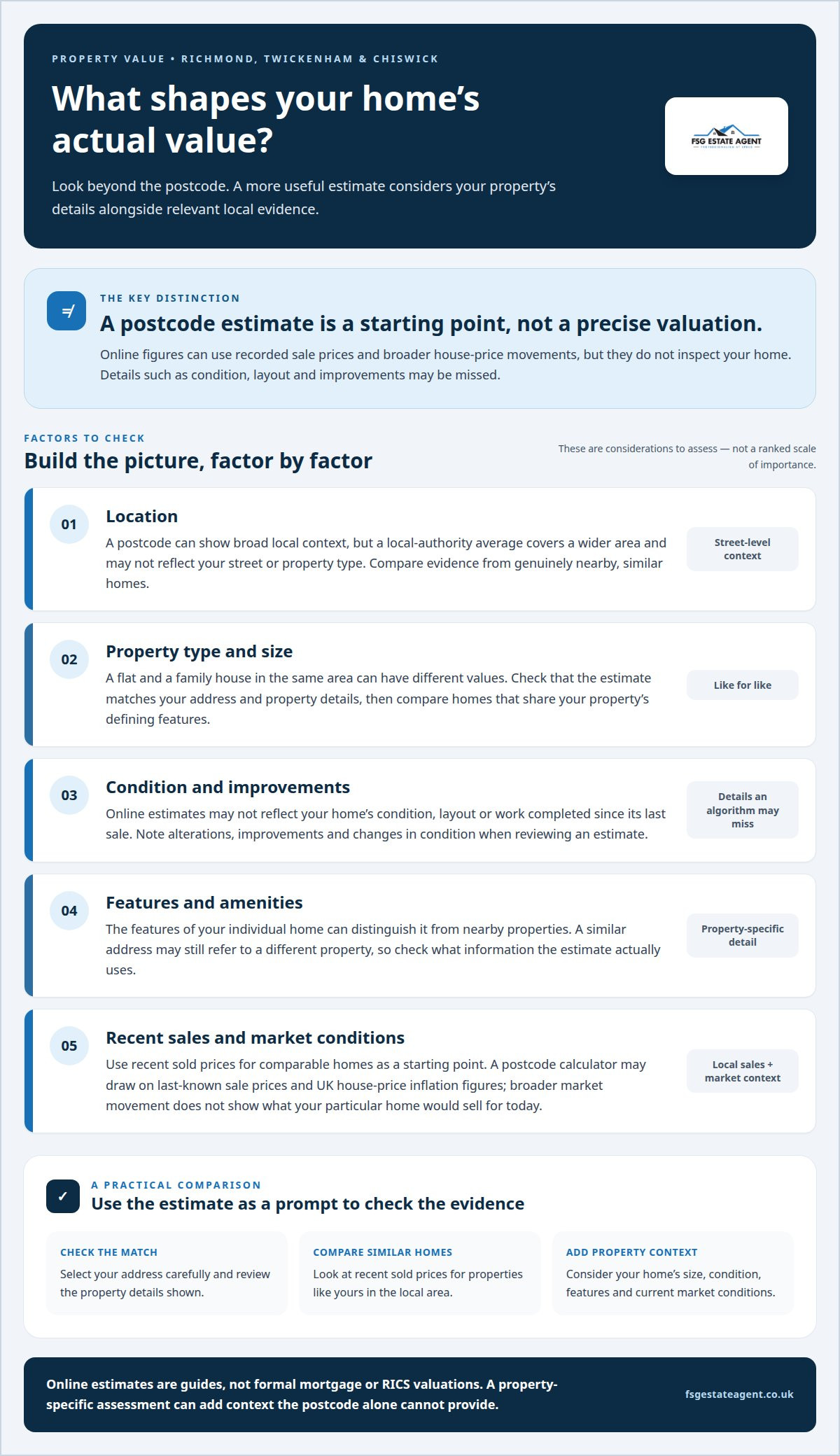
Start by checking whether the estimate reflects your address and property type. The calculator uses last known sale prices and UK house price inflation figures, so its result may differ from your home’s actual value. Location, size, condition, amenities and market conditions also influence value. A similar address nearby may still refer to a different property.
To use a calculator, select your address carefully and check the property details it displays. An incorrect or incomplete match makes the result less relevant. Then compare the estimate with recent sales of homes like yours in Richmond, Twickenham or Chiswick. Look beyond the postcode: a local authority average covers a wider area and may not reflect your street or property type.
For a wider view, use the house price index to explore UK house price averages by region, county or local authority. A calculator’s estimate reflects how value has changed over the past year. That movement provides useful context, but it does not show what your particular home would sell for today. Your property’s features and local evidence still matter.
Use the result as a starting point for decisions, not as a formal mortgage or RICS valuation. The calculator’s figure may be above or below your home’s actual value because it relies on recorded sales and broader inflation figures. Don’t use it as the sole basis for buying or selling. If you’re preparing to sell, an estate agent’s appraisal can consider the property itself and current local evidence.
For a property-specific view, you can arrange a property valuation informed by your home’s details. This helps put a postcode estimate into context before you decide how to proceed.
Factors that can affect a property’s actual value
A home’s value reflects several connected factors, not its postcode alone. In Richmond, Twickenham and Chiswick, compare your property’s features with local market evidence.
Checking value by postcode
A postcode estimate can show the broad direction of local values, but it groups different homes together. A flat and a family house in the same area may have different values because their type, size, condition and amenities differ. Use the postcode figure as context, then compare it with properties that share your home’s defining features.
Has your property changed since its last sale? Note improvements, alterations and changes in condition before interpreting an online estimate. A calculator may rely on earlier sale information and wider market movements, so it may not reflect work completed inside your home. An estate agent can consider those details alongside comparable local evidence when assessing the property.
Value from home improvements
Home improvements can affect how buyers assess a property, particularly when they improve its condition or make rooms more practical. For example, a refreshed kitchen, repaired bathroom or redecorated living space may present better than a home needing visible work. The effect depends on the quality of the work and how well it suits the property, not simply the amount spent.
Before starting a project, list its purpose and the parts of the home it will change. A new kitchen may improve presentation, while resolving a maintenance issue may address a concern buyers notice. Neither guarantees an increase in value. Ask an estate agent to assess the completed work against local comparable homes, rather than treating renovation costs as added value.
Location and property characteristics
How do location, property type, size and condition affect local property prices? Location shapes the market context; property type and size help identify fair comparisons. Condition and amenities then distinguish your home from similar properties in Richmond, Twickenham or Chiswick. A spacious, well-presented house and a smaller flat nearby are not direct equivalents.
For a flat, lease length, service charges and ground rent also matter. A shorter lease can affect a buyer’s assessment, while service charges and ground rent contribute to ongoing costs. Have the lease details and current charges ready when arranging a valuation. They provide useful context alongside the flat’s size, condition and location.
To organise your evidence, note the property type, approximate size, condition, amenities and any improvements. For a flat, add the lease details and charges. This information helps an estate agent explain why your home’s value may differ from a broad postcode estimate and which local comparisons are most relevant.
Recent local sold prices and comparable properties
Recent sold prices show what buyers paid, rather than what sellers hoped to achieve. In Richmond, Twickenham and Chiswick, use them alongside closely matched properties to build a grounded view of your home’s selling position.
Previous sale prices
You can search for the sale price of a property in England or Wales. HM Land Registry sold-price data covers residential transactions in both countries. Search by property address, then note the sale price and transaction date. Check that the record refers to the right home, particularly where nearby addresses are similar.
Record the date beside each result. A sale from a different market period may offer less useful context than a recent transaction. Recent sales can also take time to appear in HM Land Registry data, so the latest local evidence may not yet show up in a search.
Comparable local properties
Choose comparable properties carefully. Start with homes close to yours in Richmond, Twickenham or Chiswick, then compare property type, size, condition and features. A nearby flat is not automatically a useful match for a house, and a substantially larger home is not a fair comparison for a smaller one.
Look for a pattern across several relevant sales instead of relying on one figure. A property value calculator may estimate a range using HM Land Registry sold prices, nearby comparable homes and property-level evidence. That range is more informative when the comparisons resemble your home and the details are accurate.
Recommended selling price ranges
A recommended selling price range should reflect the evidence, not just the highest nearby sale. Consider the properties selected, their sale dates and how closely they resemble your home. If one result differs notably, check whether its size, condition or property type explains the gap before treating it as a useful guide.
Use the range to inform a selling decision, then test its reasoning against local evidence. For example, compare the sold price of a similar home with your property’s condition and features. An asking price is a marketing decision, while recorded sold prices reflect completed transactions. Keeping those figures distinct helps you understand how a suggested range was formed.
For a practical comparison, make a short record of each relevant sale: address, transaction date, sold price and key similarities. Set aside homes that differ substantially rather than averaging them together. If recent sales are limited, widen the search carefully and note where properties differ. This gives you a clearer basis for discussing an asking price and avoids treating every nearby result as equivalent.
Comparing nearby properties
A useful comparison is more than a nearby address and a sold price. For a home in Richmond, Twickenham or Chiswick, match the property type and features first, then assess how well each example reflects yours.
Start with the closest relevant homes, but don’t assume proximity makes them equivalent. A flat and a house can sit on the same street yet attract different buyers. Compare homes with a similar layout, size and condition. If the nearest sale differs on these points, note the difference rather than treating its price as a direct guide.
Consider the property’s setting within the area, too. Two homes in Twickenham may have different surroundings or access to amenities, which can affect how buyers view them. Check whether each comparison offers similar outdoor space, parking or other features. These details help explain why homes with similar addresses can achieve different prices.
Next, review the condition and presentation shown in each listing or property record. A recently improved interior may appeal differently from a home that needs work. Account for that distinction instead of assuming both properties would attract the same response. Note visible differences and any details that make one example a weaker match.
Market conditions matter as well. The same property can attract different levels of buyer interest as local conditions change. Consider whether a sale reflects the current market, and note the timing when using an older example. Demand for one property type can also differ from demand for another, even within Richmond, Twickenham or Chiswick.
A simple comparison report makes your reasoning clearer. For each sale, record its address, property type, sale date, price and distinguishing features. Note why it is comparable or what makes it less relevant. This gives you a transparent basis for weighing evidence, rather than selecting only the highest sale or the closest address.
Use the strongest matches to understand a potential value range, not to claim an exact like-for-like result. If every nearby property differs in size, condition or layout, give more weight to those that share your home’s most important characteristics. Explain the differences as well as the similarities.
Before setting an asking price, bring your comparison notes together with your property’s own features and current market evidence. A property valuation can help assess how those examples relate to your home and its likely buyers. Discuss a local property valuation to put your comparisons into context.
FSG Estate Agent: Property Sales Agency Service
If you’re considering selling, FSG Estate Agent can turn your local price research into a clear next step. Its Property Sales Agency Service manages the process from valuation through to completion, combining local property expertise, professional marketing and proactive sales progression.
A property-specific valuation can help you weigh comparable sold prices against your home’s features and current market evidence. It’s a useful next step when an online estimate leaves questions or you’re preparing to decide how to sell. FSG Estate Agent provides a personal, proactive service, with attention to both your property and the progress of the sale.
To discuss your property and possible next steps, contact FSG Estate Agent.
Turn your estimate into a considered next step
If you’re still asking what your property is worth, focus on what you need the figure to help you decide. Selling, planning a future move or simply understanding your position each calls for a different conversation. Being clear about your aim helps make a valuation useful, rather than just another number to compare.
Before speaking with an adviser, note the questions that matter most to you. You might want to understand how your home could be presented, what would shape an asking price or how the sale would be managed. You don’t need to have every decision made. A clear starting point makes it easier to discuss your options and decide what feels right.
For a personal conversation about selling in Richmond or Twickenham, contact FSG Estate Agent. Take the next step at your own pace, with a clearer idea of what you want to achieve.
Frequently Asked Questions
How much is my house worth?
To answer “What is my property worth?”, compare your home with similar properties sold in Richmond, Twickenham or Chiswick, then account for its individual features. Note its property type, condition and size before reviewing local sales. If you’re considering selling, a property-specific valuation can turn those comparisons into a considered asking-price range. The figure can inform your decision, but cannot promise the eventual sale price.
How accurate is an online house valuation?
An online house valuation is an estimate, and its usefulness depends on the property information and sales evidence behind it. For a more individual answer to “What is my property worth?”, consider details the tool may miss, such as an extension, a refurbished room or a particular outlook. Check that the address and property details match your home, then compare the result with an assessment that considers the property itself.
What factors affect a property’s value in the UK?
Location, property type, size, condition, amenities and market conditions all affect value. For a flat, lease length and ongoing charges also matter to buyers. Consider how these factors work together: a well-presented property may still differ from a similar home with a different layout or setting. In Richmond, Twickenham and Chiswick, use comparable properties to understand which features shape the local evidence.
Which UK property valuation websites provide estimates?
UK house value calculators can estimate a property’s value after you select its address. For context, the UK house price index lets you explore average prices by region, county or local authority. HM Land Registry provides residential sold-price data for England and Wales, not an individual home valuation. Use calculators for an initial estimate and sold-price records to examine completed transactions, keeping the two types of information distinct.
How accurate are online house valuation tools?
Accuracy depends on the records and assumptions a tool uses. Two calculators may show different estimates if they use different comparable sales or market adjustments. Treat a wide gap as a reason to inspect the underlying details, not to choose the higher figure. Check the address, property type and known features, then compare the result with local sold-price evidence before using it to guide a selling decision.
How do estate agents value a property, and is it free?
An estate agent assesses a home using its features and current local market evidence, either during a visit or through details shared virtually. The valuation helps sellers consider an asking-price strategy. FSG Estate Agent provides a free, no-obligation property valuation, so you can discuss your home’s likely market position without committing to a sale. Share relevant details, including improvements and, for a leasehold home, its costs and charges.
How can I compare my property with similar homes currently for sale?
Compare current listings with your home by matching property type, size, layout, condition and features. Note differences such as outdoor space or parking, rather than treating a nearby listing as identical. Asking prices show what sellers are seeking, not what buyers have paid. Use listings to understand the homes competing for attention, then weigh them separately from completed sales when considering your own position.
How do renovations and energy efficiency affect a property’s value?
Renovations can improve a home’s condition and presentation, but their effect depends on the work, finish and property. Keep records of completed improvements and describe what changed, rather than assuming the project cost adds the same amount to value. Energy efficiency may also shape a buyer’s view of a home’s running costs. Consider documented upgrades alongside the property’s condition and local comparable evidence when discussing value.